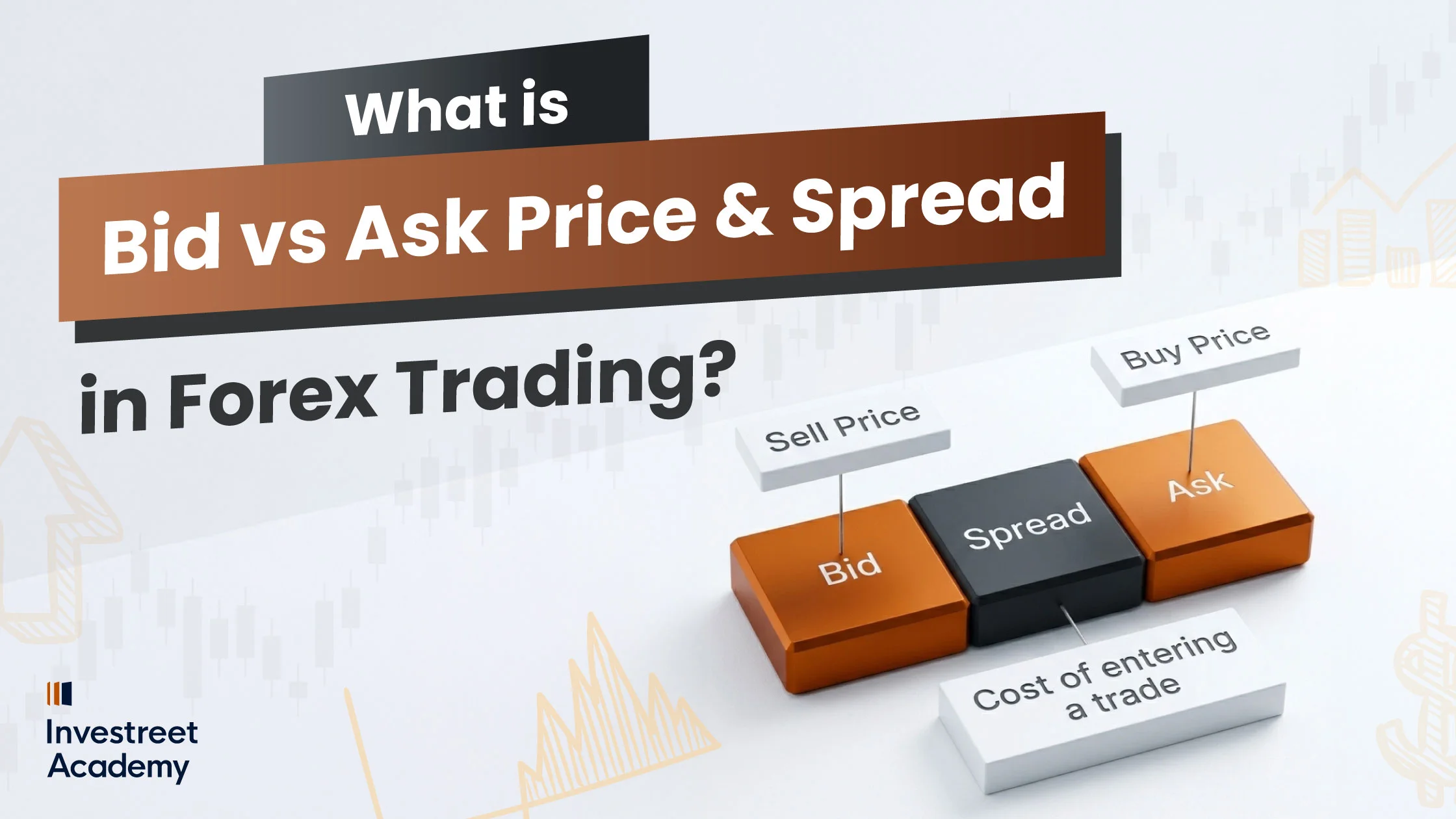
If you are going to trade Forex successfully, you need to master one of its most fundamental concepts: Bid vs Ask (Spread). Understanding how bid and ask prices work and how they relate to the spread is essential for every trader.
Simply put, the buying price is the selling price, and the selling price is the buying price. Ask price – bid price = spread.
In this article, we’ll cover what bid and ask prices are, explain the bid-ask spread and how to calculate it, explore the different types of spreads, and explain what the spread can tell you about the market. We’ll also discuss how to profit from the bid-ask spread, how to manage forex spreads within your trading strategy, and what constitutes a good spread in forex.
What Are The Forex Bid and Ask Prices?
- Bid and Ask Meaning
Bid price: The price at which you can SELL a currency pair. It’s the highest price buyers are willing to pay for the base currency.
Ask (offer) price: The price at which you can BUY a currency pair. It’s the lowest price sellers are willing to accept for the base currency.
For Example:
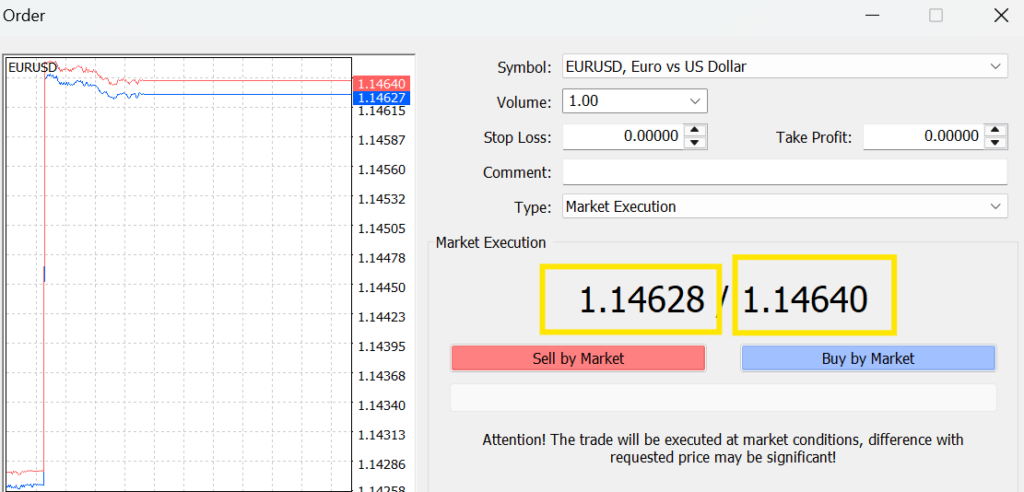
The currency pair (EUR/USD) has a Bid price of 1.14628 and an ask price of 1.14640.
- If you sell EUR/USD, you’ll get 1.14628 (bid).
- If you buy EUR/USD, you’ll pay 1.14640 (ask).
- Bid vs. Ask Price: Key Differences
The following table illustrates the difference between the bid rate and the ask rate, using an example and explaining what it means for traders:
| Bid Price | Ask Price | |
| Definition | The price at which the market buys from you. | The price at which the market sells to you. |
| Represents | The buyer’s maximum price. | The seller’s minimum price. |
| Example (EUR/USD) | 1.14628 | 1.14640 |
| What It Means for Traders | You use the bid price when you sell a currency pair. | You use the ask price when you buy a currency pair. |
You now understand what bid and ask mean. The next step is answering a key question every trader has: how are bid and ask prices actually determined?
How Are the Bid and Ask Prices Determined?
Bid and ask prices aren’t random. Market forces drive them. Here’s a simple breakdown of how they are determined:
- Market Forces:
Bid and ask prices are determined by the market through the buying and selling decisions of traders and institutions.
- Demand > Supply:
If demand exceeds supply, both bid and ask prices gradually move upward.
- Supply > Demand:
If supply exceeds demand, both bid and ask prices gradually drift downward.
Changes in supply and demand can influence the difference between the bid and ask prices, known as the bid-ask spread, which in turn impacts open trades. So, let’s first understand what a bid-ask spread is.
What Is A Bid Ask Spread?
The bid-ask spread is the difference between the bid price (the amount buyers are willing to pay) and the ask price (the amount sellers are willing to accept) for a currency pair or asset.
Spread:
The difference between the bid and ask price. It represents the cost of the trade and the broker’s or market maker’s compensation. A smaller spread typically indicates higher liquidity and lower trading costs; a larger spread can occur during news events or in less liquid pairs.
- A narrow spread usually indicates a highly liquid market with low transaction costs.
- A wide spread often signals lower liquidity or higher volatility.
The number of bids and asks (supply and demand) significantly influences the bid-ask spread. When fewer participants submit buy orders for a security, there are fewer bid prices, and the spread tends to widen. The same occurs when sellers submit a limited number of orders to sell a security.
For a deeper understanding, once you’re familiar with the concept of the bid-ask spread, it’s essential to learn how to calculate it.
How to Calculate Bid-Ask Rate?
The bid-ask spread is the difference between the ask price (the price to buy) and the bid price (the price to sell) for a currency pair or asset. For Forex traders, understanding how to calculate the spread is crucial because it directly affects trading costs and profitability.
For Example (EUR/USD):
Ask: 1.14640 – Bid: 1.14628, The spread is 0.00012, which equals 1.2 pips.
Spread Formula:
Bid-Ask Spread = Ask Price − Bid Price
There are more advanced bid-ask spread calculations typically used by institutional traders, market makers, high-frequency traders, brokers, and exchanges. It’s good to know what it is and why/when they use it.
The following table illustrates what is beyond the Basic Bid-Ask Spread Calculations:
| Method | What It Is | Why/When to Use It |
| Weighted Average Spread | A calculation that factors in multiple tiers of bids and asks, taking into account the distribution of orders at different price levels | Useful in volatile markets or when the order book has multiple bid/ask levels, giving a more accurate picture of the spread |
| Effective Spread | Measures the difference between the execution price of a market order and the midpoint of the bid-ask spread. | Reflects the actual cost of trading, especially in highly liquid and fast-moving markets. |
| Percentage Spread | Converts the bid-ask spread into a percentage of the asset’s price; for example, a $1 spread on a $50 stock equals 2%. | Makes it easier to compare spreads across different assets with varying prices. |
After explaining how to calculate the bid-ask spread, it’s important to understand that there are two main types of spreads.
What Are The Types of Bid-Ask Spreads?
The table below illustrates the two main types of spreads in Forex trading, their definitions, and their pros and cons:
| Type of Spread | What It Is | Pros | Cons |
| Fixed Spread | A spread that stays the same regardless of market volatility. | Easy to predict trading costs. | It can be slightly higher than variable spreads during normal conditions. |
| No sudden widening during news events. | |||
| The broker keeps it constant. | Good for beginners learning risk control. | Some brokers may still adjust during extreme volatility. | |
| Variable Spread | A spread that changes depending on market conditions and liquidity. | Usually tighter during high liquidity times. | It can widen sharply during news or low liquidity. |
| It can save costs for active traders. | |||
| It reflects real market conditions. | Harder to predict trading costs in fast-moving markets. |
Most traders prefer variable spreads due to potentially lower costs during active sessions, while beginners often start with fixed spreads because they are easier to plan around. Choosing between these types of spreads can depend on the trading strategy the trader applies.
Scalpers prefer variable spreads for tighter costs during peak liquidity, while swing traders can work with either type, often choosing fixed spreads to help manage risk during uncertain events.
Understanding the types of spreads is essential because they directly affect your trading costs and risk management. Choosing between fixed and variable spreads allows you to match your trading style, whether you need predictable costs for long-term positions or tighter spreads for scalping in high-liquidity conditions.
It also helps you prepare for different market conditions, as variable spreads can widen in volatile times while fixed spreads offer more stability. Knowing these differences ensures better control over expenses and helps you select the right broker for your strategy.
Now that you understand the types of spreads, it’s time to address an important question: What does the bid-ask spread tell you?
What Does The Bid-Ask Spread Tell You?
The bid-ask spread is more than just a figure; it offers insights into market conditions, trading costs, and overall liquidity. Understanding what the spread indicates helps traders make better decisions and manage risk efficiently.
Liquidity Indicator
A narrow spread indicates a highly liquid and active market, making it easier to enter and exit trades with minimal cost, while a wide spread suggests low liquidity and reduced market activity, which generally results in higher transaction costs.
Market Volatility:
Spreads often widen during volatile periods, such as significant news events or sudden price shifts. A rapid increase in the spread may serve as a warning indicator of market uncertainty or upcoming volatility.
Trading Costs:
The spread is essentially the hidden cost of every trade, representing the difference between the buy (ask) and sell (bid) price. Tighter spreads mean lower costs, which is crucial for active traders and scalpers.
Market Sentiment:
In some markets, changes in the spread can indicate supply and demand pressures.
For instance, a narrowing spread may suggest strong participation from buyers and sellers, while a widening spread might point to imbalance or hesitation.
Example:
EUR/USD: Bid = 1.1000, Ask = 1.1002 → Spread = 2 pips
What it tells you: A 2-pip spread in a major currency pair suggests high liquidity and a stable, active market with low transaction costs.
Once you’re familiar with the concepts of bid, ask, and spread, it’s essential to understand how to manage the spread in your trading strategy.
Forex Bid-Ask Spread Compared to Other Financial Products
When comparing the bid-ask spread in Forex to other financial instruments, it’s essential to understand the implications of these differences on trading strategies and costs.
| Financial Instrument | Bid Price | Ask Price | Spread | Spread Unit |
| Forex (e.g., EUR/USD) | 1.14628 | 1.1464 | 0.00012 | 1.2 pips |
| Stocks (e.g., AAPL) | $150.00 | $150.10 | $0.10 | $0.10 |
| Commodities (e.g., Gold) | $1,900.00 | $1,900.50 | $0.50 | $0.50 |
| Futures (e.g., Crude Oil) | $70.00 | $70.05 | $0.05 | $0.05 |
| Cryptocurrencies (e.g., BTC) | $30,000.00 | $30,100.00 | $100.00 | $100.00 |
Explanation:
- Bid Price: The price at which an investor can sell the asset.
- Ask Price: The price at which an investor can buy the asset.
- Spread: The difference between the bid and ask prices.
- Spread Unit: Indicates the unit of the spread Forex is typically expressed in “pips,” while stocks and commodities are expressed in currency units.
Remark:
$0.00012 per EUR
0.1 standard lot = 10,000 EUR
Pip value = 0.0001 × 10,000 = $1 per pip
Spread value = 0.00012 × 10,000 = $1.20
- Lower Transaction Costs: The spreads in Forex are generally much tighter compared to stocks, commodities, and cryptocurrencies. This means traders can enter and exit positions at lower cost, making Forex trading more attractive to active traders and scalpers who rely on quick trades for small profits.
- Market Liquidity: Forex markets are among the most liquid globally, reflected in tighter bid-ask spreads. High liquidity ensures that orders can be executed quickly with minimal price movement, reducing slippage and enhancing trading efficiency.
- Volatility Considerations: While Forex spreads are typically narrow, they can widen during high volatility events, such as economic announcements or geopolitical tensions. Understanding this can help traders prepare for potential cost increases and adjust their strategies accordingly.
- Strategic Planning: By recognizing the differences in spreads across various financial products, traders can tailor their strategies. For instance, a trader may choose to focus on Forex during times of high liquidity while being cautious with stocks or commodities that may have wider spreads during the same periods.
- Broker Selection: The choice of broker can significantly influence the spread you encounter. Some brokers offer fixed spreads, while others provide variable spreads depending on market conditions. It’s crucial to choose a broker that aligns with your trading style and strategy.
How to Manage Bid-Ask Spread Risks in Your Forex Trading Strategy?
After covering the basics of the bid-ask spread along with bid and ask prices, it’s time to move to a critical point: how to manage the risks that come from this spread while trading.
To avoid paying high costs from wide spreads, keep the following tips in mind while trading:
Choose The Right Trading Sessions to Reduce Spreads:
Trading during major market sessions with high liquidity, such as the London or New York sessions, usually results in tighter spreads and lower costs. You can learn more about trading sessions and all you need to know about forex trading from our guide: Forex Trading 101?
Use Limit Orders to Manage Costs:
Placing limit orders instead of market orders lets you control the price at which you enter a trade, helping to avoid paying wide spreads in volatile markets. You can learn more about risk management from our guide: Top Forex Risk Management Strategies.