Trading comes in many forms, each with its own pace. So, what is scalping? Scalping is one of the fastest trading styles, focused on speed, precision, and seizing small opportunities before they vanish. Unlike traditional traders who wait for big market moves, scalpers aim for quick, frequent wins, entering and exiting trades in seconds or minutes. It can be really rewarding if follow the right strategy and discipline.
Through this article, you will learn what scalping is, how it works, risk management techniques, the main strategies you can use and tips for rookie scalpers, helping you understand this fast-paced trading style and see if it is suitable for you.
What is scalping in trading?
Scalping is a short-term trading style where traders aim to make many small profits by opening and closing trades very quickly. Instead of waiting for large price movements, scalpers take advantage of tiny price changes that happen throughout the day.
Simply, a scalper enters a trade, captures a small gain within seconds or minutes, and then exits the market. By repeating this process many times, these small profits can add up over multiple trades.
Trades are usually held for a very short period, typically from seconds to a few minutes. Scalpers use very short timeframes, mainly 1 minute and 5 minutes charts to identify quick price movements and execute fast trades.
Scalping works best in highly liquid markets with tight spreads, such as major forex pairs and stock indices, while many commodities are less suitable due to wider spreads and lower liquidity, though some like gold or crude oil, can still be scalped during peak trading hours.
Scalpers rely on technical trading indicators that help spot short-term price movements and entry or exit points. Commonly used indicators include:
- Moving Averages (MA): identify trend direction and short-term momentum.
- Relative Strength Index (RSI): signals overbought or oversold conditions and momentum.
- Bollinger Bands: show volatility and potential price reversal points.
- MACD: indicates momentum shifts and trend changes.
- Volume Indicators: confirm price moves and indicate buying and selling pressure.
Now that we know what scalping is, let’s see how it actually works in practice.
How does scalping simply work in trading?
- Choose a highly liquid market, like major forex pairs (EUR/USD, USD/JPY) or stock indices (S&P 500, NASDAQ).
- Use short timeframes, such as 1-minute, 5-minute, or tick charts, to spot tiny price movements. And indicators such as Moving averages, MACD, or Trendline to solidify the accuracy of your strategy.
- Enter and exit quickly, holding positions for only a few seconds to a few minutes.
Example:
- Let’s say you decide to buy 0.01 lots of EUR/USD at 1.1000.
- This means you are buying 1,100 euros (0.01 lots = 1,100 euros).
- If EUR/USD moves to 1.101, you gain 1 euro in a few seconds or minutes.
- Take advantage of tight spreads, since small profits matter and low trading costs are crucial.
- Use risk management by setting stop-losses and limiting position size to avoid large losses.
- Repeat this many times per day aiming for multiple trades to accumulate profits.
Now that we have seen how it works, let’s explore how scalping differs from other trading styles.
How does scalping differ from other trading styles?
Aside from scalping, other commonly used trading styles, such as day trading, swing trading, and position trading. Each style has its own approach to timeframes, risk, and profit targets. The following table highlights the key differences between scalping and these other trading styles.
| Scalping | Day Trading | Swing Trading | Positing Trading | |
| Holding period | Seconds to a few minutes | Minutes to several hours (closed before market close) | Several days to a few weeks | Weeks to months or longer |
| Trading Frequency | Very high, often 10 – 50+ trades per day | Moderate around 2 – 10 trades per day | Low, often a few trades per week | Very low, few trades per month |
| Chart Timeframes | 1min, 5 min, 15min | 15 min, 30 min | 1 hour, 4 hours, daily | Daily and weekly charts |
| Profit target per trade | Very small price moves | Small intraday price moves | Medium price swings | Strong long-term trends |
| Market Exposure | Extremely short exposure as positions close quickly | No overnight exposure | Overnight and multi-day exposure | Long-term exposure to market movements |
| Monitoring Required | Constant monitoring during trading session | Several hours of active monitoring | Occasional monitoring (often once or twice daily) | Minimal monitoring (few times per week) |
| Analysis Used | Mostly short-term technical analysis and price action | Mainly technical analysis | Technical analysis and some fundamental analysis | Mainly fundamental analysis |
Since scalping involves fast trades and frequent market exposure, managing risk effectively is essential to protect your capital. So, let’s explore how?
How to use risk management in scalping?
- Use tight stop-loss orders to limit potential losses if the market moves against the position.
- Risk only a small percentage of trading capital per trade to protect the account from consecutive losses.
- Aim for a balanced risk-to-reward ratio, even when targeting small price movements.
- Avoid opening too many trades simultaneously to prevent excessive exposure to market volatility.
- Focus on highly liquid markets to benefit from tighter spreads and faster order execution.
- Adjust position size based on account size to keep risk per trade consistent.
- Follow a disciplined trading plan and avoid impulsive decisions during fast-moving markets.
It’s also important to be aware of the pros and cons of scalping to make informed trading decisions and manage your expectations.
Pros and cons of scalping trading:
Every trading style has its pros and cons and scalping is no exception. The table below highlights the key advantages and disadvantages of this fast-paced trading approach.
| Pros | Cons |
| Allows traders to capture small price movements, potentially generating small profits from many trades throughout the day. | Profits are very tiny, meaning traders must execute many trades to achieve meaningful returns. |
| Positions are usually held for seconds to minutes, reducing exposure to large market swings or overnight events. | Instant decisions are required as positions are held for a very short time period, leaving little time for analysis. |
| Active market sessions (ex: London or New York in forex) provide strong volatility for scalping. | Requires constant market monitoring during active hours and sessions which can be exhausting for some traders. |
| Reduced exposure to overnight risks, macro news, and gap openings since trades are closed quickly. | Frequent trades increase exposure to execution errors and market noise. |
| No overnight swap or rollover fees since trades close quickly. | High trading frequency leads to significant transaction costs like spreads and commissions. |
| Some traders enjoy the fast-paced and active trading style. | The rapid pace can cause stress, mental fatigue and emotional decision-making. |
| Can work in both trending and range-bound markets when volatility is present. | Less effective in low-volatility or illiquid markets where prices move slowly. |
After reviewing the pros and cons, let’s explore the main types of scalping strategies traders use to capture quick profits.
6 key types of scalping strategies:
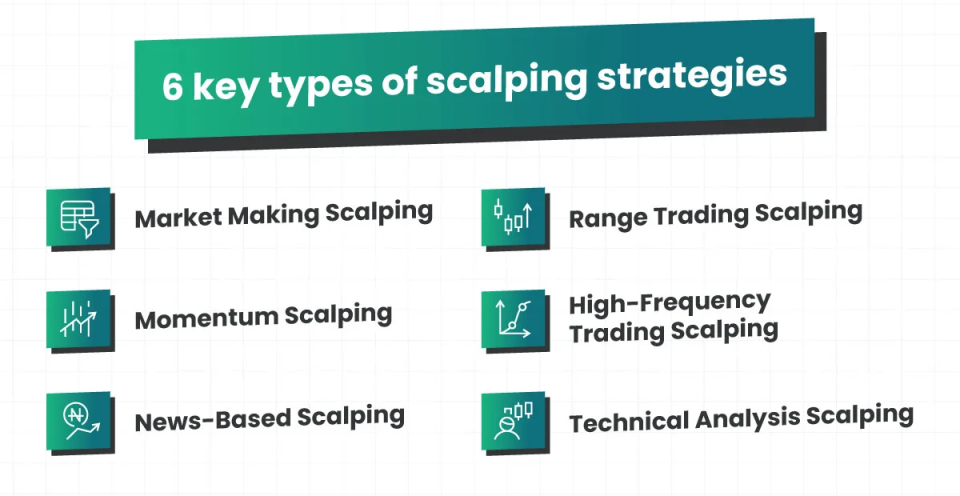
Scalpers use different strategies depending on their goals, market conditions, and trading style. The following six strategies are among the most commonly used to capture quick, small profits in fast-moving markets.
- Market Making Scalping:
This strategy involves taking advantage of very small price differences between the bid and ask prices or what is known as the spread.Traders act almost like mini market makers themselves, buying at the bid and selling at the ask repeatedly to make tiny profits that add up over many trades.
- Traders monitor a highly liquid market.
- They place buy orders just below the current price and sell orders just above it.
- When the price moves slightly, they close positions quickly often within seconds to minutes.
- Profit per trade is small but frequent trades can make the strategy profitable.
- Momentum Scalping:
Focuses on achieving profits from strong price movements in one direction either up or down. Traders try to catch the start of a strong upward or downward move and exit quickly for a small gain before the momentum ends.
- Traders identify strong momentum using technical indicators such as moving averages, RSI, MACD, or chart patterns.
- They enter a trade in the direction of the momentum (buy if the price is rising or sell if the price is falling).
- Positions are held very briefly, often a few seconds to a few minutes aiming for small and quick profits.
- Traders exit quickly once momentum slows or reverses.
- News-Based Scalping:
Aims to profit from sudden price movements caused by breaking news or economic data releases. Traders aim to react very quickly to market-moving events and capture small gains before the volatility settles.
- Traders monitor the economic calendar for important events (like CPI releases, central bank decisions or geopolitical news).
- Immediately after the news is released, they enter trades in the direction of the market reaction.
- Positions are held for a very short time, often seconds to a few minutes to capitalize on the initial spike or drop.
- Traders exit quickly because volatility driven by news can reverse quickly.
- Range Trading Scalping:
Seeks to profit from price movements within a defined support and resistance range, it works well in low volatility markets. Traders repeatedly buy near the support level and sell near the resistance level, capturing small price movements as the market fluctuates within the range
- Traders identify a sideways market where prices move between clear support and resistance levels.
- They enter buy trades near support where the price is expected to bounce upward.
- They enter sell trades near resistance where the price is expected to move downward.
- Positions are held for a very short time usually seconds to minutes and traders exit once a small profit target is reached.
- High-Frequency Trading Scalping:
The strategy relies on using advanced algorithms and extremely fast computer systems to execute a large number of trades within milliseconds. It is extremely fast automated scalping; the goal is to capture very small price differences repeatedly, generating profit through high trading volume.
- Traders use automated algorithms to analyse market data and identify very small trading opportunities.
- The system places and executes orders almost instantly, often within milliseconds.
- Positions are held for extremely short periods, sometimes less than a second.
- Profits come from many small trades executed at very high speed.
- Technical Analysis Scalping:
This strategy relies entirely on charts, indicators, and price patterns to make very short-term trades. Traders analyse price movements, trends, and signals to enter and exit trades quickly for small profits.
- The trader studies technical indicators such as moving averages, Bollinger Bands, RSI, MACD, or candlestick patterns.
- They enter trades based on signals like trend reversals, breakouts, or overbought and oversold conditions.
- Positions are held briefly, usually seconds to minutes, aiming for small quick gains.
- Traders often combine multiple indicators to confirm entry and exit points.
After learning about the main scalping strategies, it’s important to consider some tips for rookie scalpers.
Can every trader use Scalping? Any Rules and Regulations?
Trading Rules:
Some brokers may impose restrictions on scalping, especially in certain markets or account types. They may set minimum holding time requirements for each trade.
Spreads and Commissions:
Scalping typically requires low spreads and commissions so that traders can profit from small price movements. Therefore, it is crucial to choose brokers that offer low trading costs.
Capital Requirements:
Some brokers may require a minimum deposit to engage in scalping. This deposit requirement usually depends on the account type and trading strategy.
For example:
Some brokers may require a minimum deposit of several hundred to several thousand dollars to open a scalping account.
Leverage Restrictions:
Scalping often requires high leverage, but some brokers may impose limits on high-leverage trading, especially in volatile markets.
Account Types:
Certain brokers offer account types specifically designed for day trading or scalping, which may feature higher leverage and lower trading costs.
Notes:
When choosing a broker, traders should carefully read the relevant terms and conditions to understand whether there are restrictions on scalping and deposit requirements. It is advisable to select brokers that support scalping and provide favorable trading conditions.
Tips for Rookie Scalpers:
- Choose the right market; it is important to focus on highly liquid instruments like major forex pairs or large-cap stocks and avoid low-volume markets as spreads and slippage will be very high.
- Pick a reliable platform with fast execution and low latency, quick order placement is crucial for scalping success.
- Trade with small positions to limit losses while learning. Avoid high leverage, which can amplify tiny price moves into big losses.
- Stick to a few strategies, avoid mixing too many scalping strategies at once, just focus on one or two till you gain confidence and consistency.
- Master technical analysis, learn how to read charts, capture trends and use key indicators like RSI or MACD to identify entry and exit points efficiently.
- Use strict risk management, always use stop-loss orders and risk only a small portion of your capital per trade to protect your account from unexpected losses.
- Practice emotional control, scalping requires quick decisions which can be stressful for many traders, stick to your plan and avoid impulsive trades.
- Beginners should avoid very high volatility and trade during stable market conditions till they gain good experience.
- Practice on demo accounts to understand timing, spreads and execution without risking real money, this will help you boost your confidence and scalping skills.
- Analyse every trading session to see what worked and what didn’t, gradually refine your strategy to improve results over time.
Bottom Line
Scalping can be an exciting and rewarding trading style, but it’s not for everyone. It requires speed, discipline, and careful risk management, along with a solid understanding of strategies and market conditions. By starting small, practising regularly and learning from each trade, rookie scalpers can gradually build the skills and confidence needed to succeed. Remember, consistent success comes from patience, preparation, and sticking to your plan, even in fast-moving markets.