When trading forex, it’s important to manage position sizing carefully. Position sizing refers to the number of units a trader invests in a specific financial instrument, such as a currency pair or commodities. When setting your position size, you should consider your total capital and risk tolerance to determine an appropriate amount.
Position sizing is key to managing risk and preventing a total balance wipeout. A helpful tool for this is the position size calculator. But how do you calculate the right position size?
In this guide, we will discuss what position sizing is, what a position size calculator is, and why position sizing is important. We will also explain when and who should use the position size calculator. In addition, we’ll provide a step-by-step guide on how the calculator works. Finally, we will outline the common mistakes traders make and what can happen if you don’t use a position size calculator.
What is a Forex Position Size Calculator?
Position size calculator is a tool to help you figure out the correct lot size for each trade. This tool tells you how much you should invest in each trade based on your risk tolerance, account size, and stop loss level. This way, you avoid risking too much of your capital on a single trade and keep your risk management under control.
When it comes to position sizing and understanding what it is, it’s also important to know why it matters for traders.
Why is Position Sizing Important?
When you stick to position sizing carefully, it helps you protect your trading account from large losses. By determining the right amount to risk on each trade based on your capital size and risk tolerance, you ensure proper risk management and keep losses within a manageable range.
Position sizing also prevents emotional trading because the risk per trade is calculated and predefined. This keeps you away from overtrading or using excessive leverage. You must calculate your position size and consider the leverage you have.
While leverage allows you to open larger positions relative to your capital, it can also magnify losses and deplete your account. Overall. Position sizing is a key tool for maintaining discipline and achieving long-term success in forex trading.
Here are the most important reasons why position sizing is important:
- Risk Management: Position sizing is a key tool for managing risk. Choosing the proper size for each trade can significantly reduce the risks that come from market volatility.
- Consistency: When each trade is sized based on a fixed risk percentage, it ensures consistent risk management across all trades.
- Flexibility and Discipline: Sticking to a predefined position size for each trade provides flexibility and helps prevent emotional or impulsive trading decisions.
Having understood the importance of position sizing, let’s explore when to use a position size calculator.
When Should Traders Use a Position Size Calculator?
Using a position size calculator is highly beneficial and can be applied in various situations. Traders should use it before entering any trade to determine the optimal trade size based on their capital and risk tolerance.
As a trader, it’s essential to stick to a position size that matches the amount you’re willing to risk per trade, helping you avoid significant losses. One of the most critical times to use a position size calculator is during volatile market conditions, when price movements can change rapidly and unpredictably.
Whether you’re a beginner still learning how to manage exposure or an experienced trader fine-tuning your strategy, using a position size calculator ensures consistent risk management in forex or other financial instruments. It helps protect your capital from unnecessary losses.
Now that you know when traders should use a position size calculator, let’s explore who should use it, just beginners or all types of traders?
Who Should Use Position Size Calculator?
All types of traders can benefit from using a position size calculator. When you use this tool, your position size is predefined, helping you avoid emotional decisions. It prevents greed and overtrading, which often occur when traders are tempted to open larger positions in pursuit of higher profits.
However, when the market reverses, this approach can quickly wipe out your balance, leading to the false belief that trading isn’t profitable. In reality, forex trading can be profitable with proper risk management tools, such as a position size calculator.
The table below illustrates who should use the position size calculator, why it matters, and provides practical examples for each.
| Trader Type | Why Using a Position Size Calculator Matters | Example |
| Beginner Trader | Helps develop discipline and risk awareness early. | A beginner trader with $1,000 capital risks 2% per trade ($20) with a 50-point stop loss and 100-point take profit. |
| Prevents emotional trading and over-leveraging small accounts. | ||
| Professional Trader | Ensures consistency across multiple trades and maintains balanced exposure even with large capital. | A professional trader with $100,000 capital risks 1% per trade ($1,000) with a 100-point stop loss and 200-point take profit. |
| Keeps risk within defined limits despite market volatility. | ||
| Anyone Focused on Long-Term Trading Success | Builds a sustainable trading approach that protects capital over time and supports steady growth. | A long-term trader risks 0.5% per trade on a $50,000 account with a 150-point stop loss and 300-point take profit. |
| Encourages patience and consistency. |
Now that you know who benefits from a position size calculator, let’s learn how to use it step by step.
How Does a Position Size Calculator Work? Step-by-step
Before placing a trade, it’s crucial to know exactly how much to risk per trade. That’s where the position size calculator comes in.
Let’s break down how it works:
- Position Size Calculator Key Inputs.
- Risk Amount Calculation.
- Stop-loss Calculation.
- Position Size Determination.
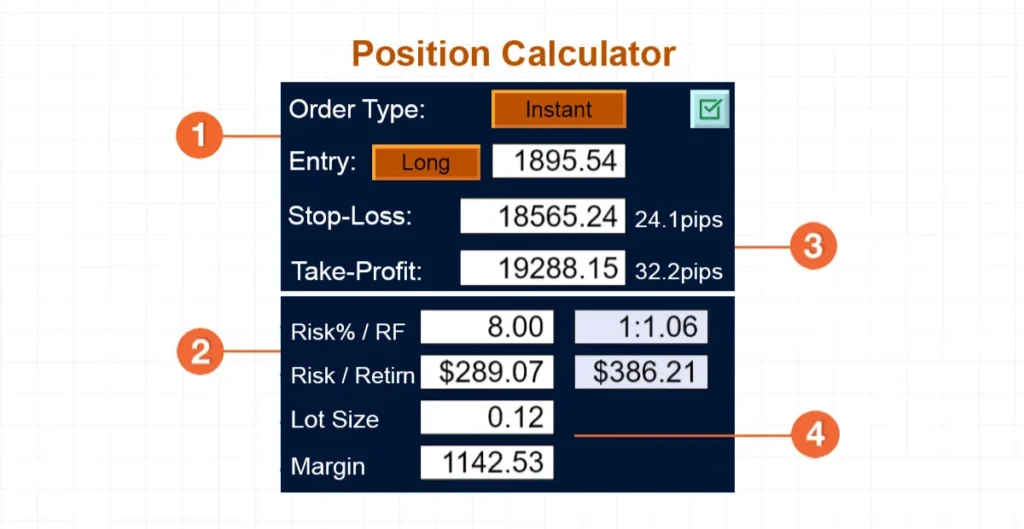
Position Size Calculator Key Inputs:
Looking at the interface of the position size calculator, you need to input several variables for the tool to calculate the optimal position size for you.
- Account Balance: Enter your total trading capital.
- Risk per Trade: Specify the percentage of your capital you are willing to risk per trade. Typically, it’s advisable to risk no more than 2% of your total capital per trade.
- Entry Price: Enter the price at which you plan to open your trading position.
- Stop Loss: Input the stop-loss level where you will exit the trade to limit potential losses.
- Trading Instrument: Choose the currency pair or financial instrument carefully, as this affects the pip value.
Risk Amount Calculation:
The tool calculates the actual amount you are risking per trade based on your inputs, applying the chosen risk percentage to your total trading capital.
For example:
If your trading capital is $50,000 and your risk per trade is 2%, your risk amount will be $1,000. On the other hand, if your capital is smaller, let’s say $1,000, you might set your risk percentage to 1%, meaning your risk amount would be $10.
This example illustrates that your risk percentage should be adjusted in accordance with your capital size and personal risk tolerance.
Stop-loss Calculation:
Then, it calculates the distance between your entry level and stop-loss level to determine the risk per unit or share.
Position Size Determination:
Finally, the calculator sets the optimal trade size by dividing the total risk amount by the risk per unit to calculate the position size.
The formula for position size is:
(Account Equity X Risk%) / Risk per unit = Position size
Now that you have learned the full picture of the position size calculator and how to use it step by step, it’s essential to understand the common mistakes traders often make so you can avoid them.
Which Mistakes Do Forex Traders Commonly Make?
In a trading journey, you must avoid common mistakes other traders make to ensure you mitigate risks that could lead to losses. Here are the most common mistakes traders make:
Risking too much per trade:
Many traders make the mistake of risking a large portion of their capital on a single trade. This can lead to significant losses, which often trigger emotional decision-making. The best practice is to risk only 1–2% of your total capital per trade. This approach helps you manage risk effectively and build long-term success in forex trading.
Ignoring stop-loss placement:
Many traders overlook the use of stop-loss orders, despite their purpose being to limit losses. If you don’t set a stop-loss level and the market moves against your position, you could end up losing your entire capital. It’s essential to set this level carefully at a point where you’re comfortable with the potential loss per trade if the market moves unfavorably.
Some traders do use stop-loss orders but misuse them by setting levels that allow for larger losses than they can afford. As a result, they assume stop-loss orders aren’t effective.
You need to be aware of the number of points or pips between your entry and stop-loss levels, ensuring it aligns with your total capital and risk tolerance.
Using a fixed lot size instead of calculated ones:
Another common mistake is trading with a fixed lot size, regardless of account balance or trade setup. This can lead to inconsistent risk levels. Instead, use a position size calculator to determine the exact lot size that matches your risk percentage and stop-loss distance.