Stocks are among the most widely recognized investment instruments, everyday investors and financial media often use “stocks” and “shares” interchangeably, knowing the technical difference, and how these instruments work, is essential for building a successful investment strategy.
From the difference between stocks and shares, to how companies issue stocks, how markets operate, and how investors evaluate and trade stocks, each element plays an important role in understanding the world of stock markets. This article will help you explore the fundamentals of stocks, explaining how they work, how investors can gain exposure to them, and the key factors to consider when trading or investing.
What is the Difference Between Stock and Share?
- Stock: A type of financial security that represents partial ownership in a company. In other words, owning stock means you hold a small ownership stake in the company and may be entitled to a share of its profits through dividends and certain voting rights, depending on the stock type.
- Share: A single unit of stock representing partial ownership in a company. A company’s ownership is divided into shares, and each share represents a fraction of that ownership.
So basically, stock is a broad concept that refers to ownership in companies in general while shares refer to the specific number of ownership units held in a particular company.
For example, an investor may own stock in several companies, such as Apple and Microsoft. More specifically, the investor may own 100 shares of Apple (AAPL) and 50 shares of Microsoft (MSFT).
It is important to note that, despite the technical distinction between the two terms, stock and shares are frequently used interchangeably in everyday language in financial markets and media. So, the terms often convey the same meaning and are commonly used to refer to equity ownership in a company.
So, in everyday discussions you can hear phrases such as buying stock and buying shares, both are actually commonly used and are generally understood to mean purchasing ownership in a company.
Beyond understanding the terminology, it is also important to recognize that stocks come in different forms, each with distinct characteristics and investment objectives.
What are the Different Types of Stocks?
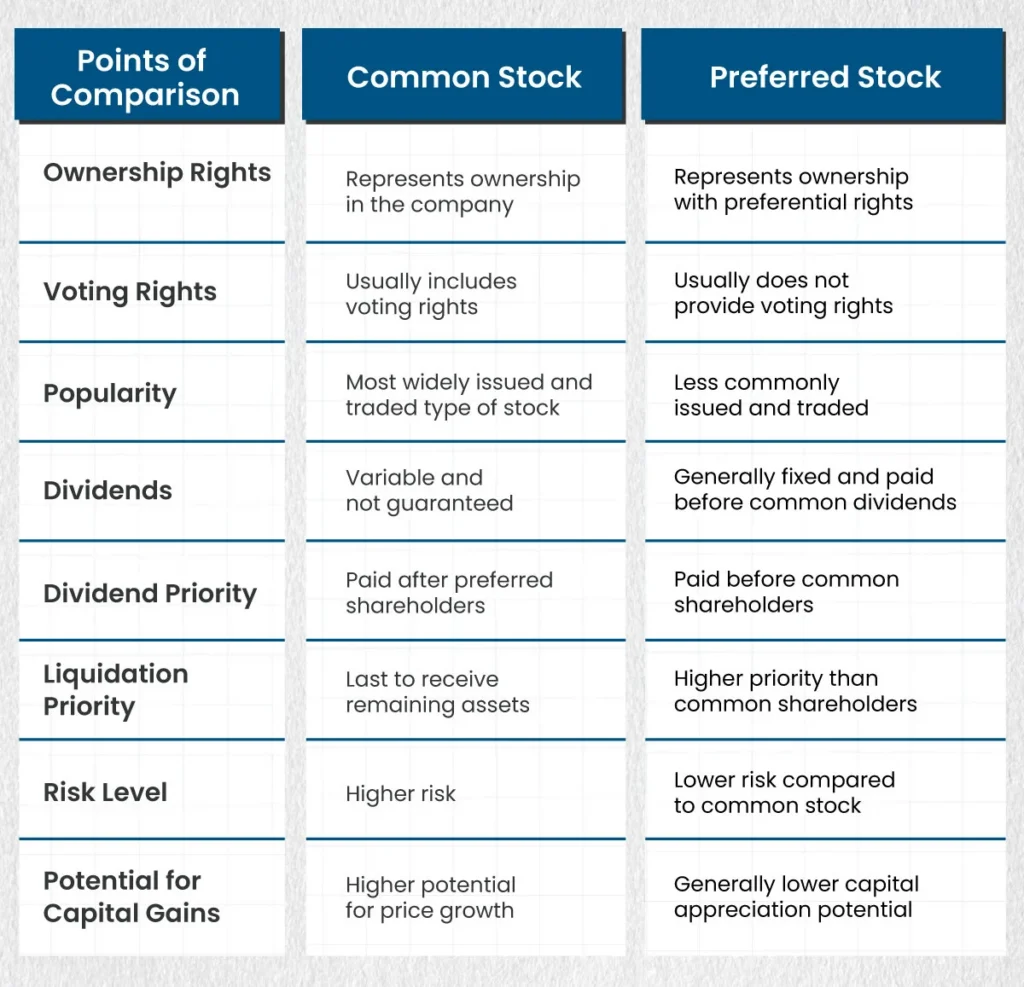
Stocks can be classified in different ways. From a legal ownership perspective, the two primary types of stocks are common stock and preferred stock.
- Common Stock: Represents ownership in a company and typically grants shareholders voting rights. Common shareholders may benefit from capital appreciation and dividends; however, dividend payments are not guaranteed.
- Preferred Stock: Is a type of equity that generally provides shareholders with fixed dividend payments and priority over common shareholders in receiving dividends and assets during liquidation. However, preferred shareholders usually have limited or no voting rights.
Note:
Common stocks account for over 90% of daily retail and institutional trading volume. When media outlets reference “stocks,” they are almost always referring to common stocks.
In addition to the legal distinction between common and preferred stocks, investors often classify stocks based on their financial and investment characteristics. Two of the most widely recognized investment categories are growth stocks and value stocks.
What are the Different Investment Classifications of Stocks?
Beyond legal structure, Wall Street classifies stocks by financial traits, market capitalization, and growth potential.
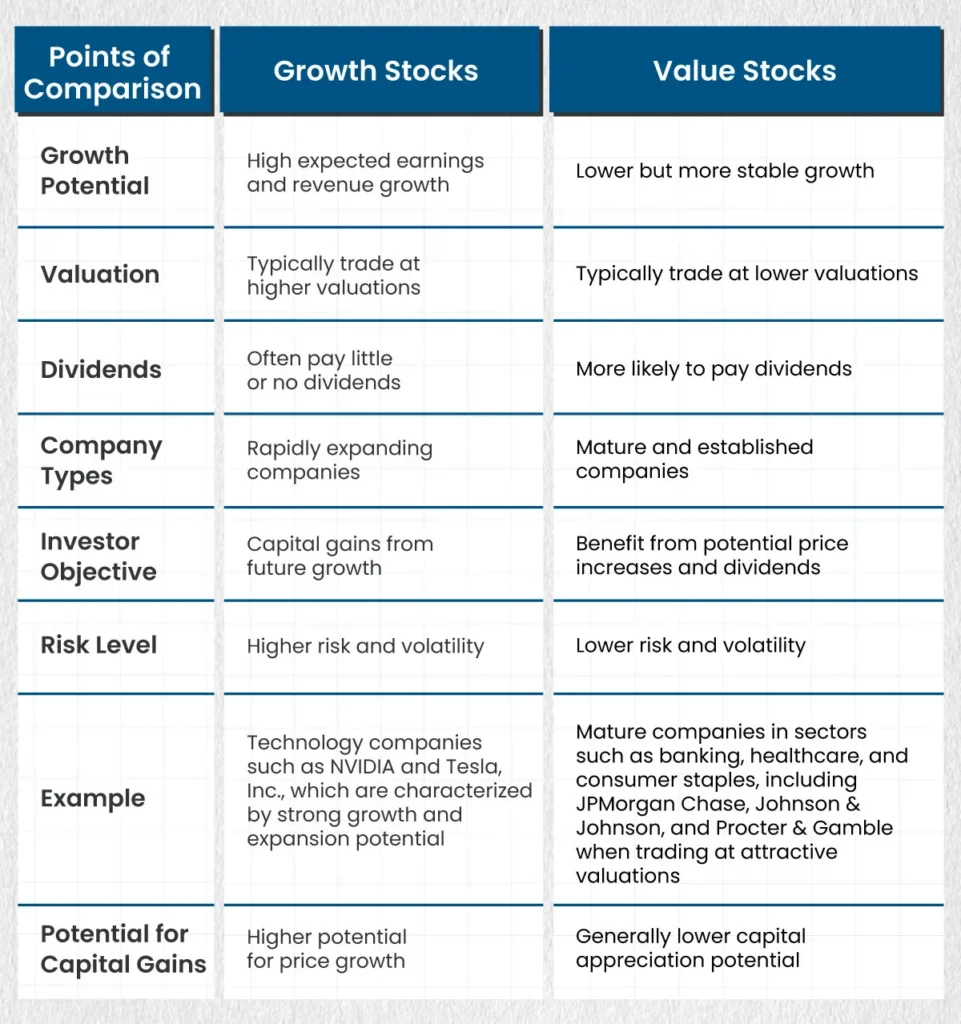
1 – Growth Stocks Vs. Value Stocks
- Growth Stocks: Are shares of companies that are expected to grow their revenues and earnings at a faster rate than the overall market. These companies often reinvest most of their profits back into the business to support expansion rather than paying dividends.
- Value Stocks: Are shares of companies that appear to be trading below their intrinsic true value based on factors such as earnings, revenue or book value. Investors buy these stocks expecting their prices to increase as the market recognizes their actual worth.
Stocks can also be classified according to their market capitalization, which refers to the total market value of a company’s outstanding shares.
2 – Large-Cap, Mid-Cap and Small-Cap Stocks
- Large-cap stocks ($10B+): Shares of large, well-established companies with high market capitalizations. They are generally considered more stable and less volatile.
- Mid-cap stocks ($2B – $10B): Shares of medium-sized companies that may offer a balance between growth potential and risk.
- Small-cap stocks ($300M – $2B): Shares of smaller companies that often have higher growth potential but may involve greater risk and price volatility.
3 – Blue Chip Stocks
Shares of large, financially strong, and well-established companies (e.g., Apple, Coca-Cola) with a long history of stable earnings and mostly offer regular dividend payments. These companies are generally considered relatively stable and are often market leaders in their industries.
Why Do Companies Issue Shares?
Going public via an Initial Public Offering (IPO) or issuing secondary shares allows corporations to access public equity capital without incurring interest debt.
- Capital Allocation for Expansion: Issuing shares provides companies with funds that can help them expand their business by financing new projects, entering new markets, investing in new product lines or services, funding research and development (R&D), and supporting mergers and acquisitions (M&A).
- Liquidity and Brand Prestige: By going public or issuing additional shares, companies can enhance their public profile and increase the liquidity of their shares, enabling investors and existing shareholders to buy or sell their holdings more easily in the market.
- Talent Retention (ESOPs): Shares are often issued or reserved for employee stock option plans (ESOPs), which help attract, retain, and motivate talent by aligning the financial interests of employees with the performance of the company.
- Debt Reduction: Companies may issue shares to raise funds to repay existing high-interest debt and reduce reliance on debt financing. Unlike debt financing, equity financing does not require mandatory interest or principal repayments, improving cash flow, lowering financial risk, and enhancing financial flexibility.
How Do Investors Make Money from Stocks?
Shareholders can make money from their investments through two main ways, capital gains and dividends.
- Capital Gains: A capital gain occurs when an investor sells a share at a higher price than the price at which it was originally purchased. The profit generated from the increase in the share price represents the investor’s return.
Capital Gain = Selling Price – Purchase Price
Example:
If an investor purchased 100 shares of a company at $10 per share, making a total investment of $1,000. If the investor later sells the shares in the stock market at $15 per share for a total of $1,500, so the capital gain = $1,500 – $1,000 = $500.
- Dividends: Dividends are payments made by a company to its shareholders from its profits. Companies may choose to distribute a portion of their earnings as dividends or retain the profits to reinvest in the business.
Dividend Income = Dividend Per Share X Number of Shares Owned
Example:
If an investor owns 200 shares in a company that declares a dividend of $0.50 per share. By applying the dividend equation, 200 × $0.50 = $100, that means the investor receives a total dividend income of $100.
Companies have a choice when it comes to their profits: reinvest them for growth or share them with shareholders. So, what makes a company decide to pay dividends?
Why Do Companies Pay Dividends If they are Not Mandatory?
Although companies are not required to distribute dividends, many choose to do so for several reasons, including attracting investors, signaling financial strength, rewarding shareholders, and distributing excess cash when profitable reinvestment opportunities are limited.
- Signal financial strength: Paying dividends can indicate that the company is profitable and has stable cash flows, which may increase investor confidence.
- Reward shareholders: Since shareholders are the owners of the company, dividends are a way of sharing the company’s success with them.
- Attract investors: Many investors, especially retirees and income-focused investors, prefer stocks that provide regular cash income through dividends.
- Limited reinvestment opportunities: Sometimes a company does not have enough profitable projects to invest all of its earnings. In this case, returning excess cash to shareholders may be more beneficial than retaining it.
After understanding what stocks are and how investors benefit from them, it is important to understand the marketplace where these transactions happen.
How Does the Stock Market Work?
The stock market is a marketplace where shares of publicly traded companies are issued, bought, and sold. Rather than being a single physical location, it consists of a network of stock exchanges and electronic trading systems that facilitate transactions between buyers and sellers. Through the stock market, companies can raise capital from investors, while investors can participate in corporate growth and potentially earn returns through capital gains and dividends.
The stock market involves several key participants:
- Companies: Issue shares to raise capital for business operations and expansion.
- Investors: Buy and sell shares to generate investment returns.
- Stock Exchanges: Provide organized platforms where securities are traded.
- Brokers: Act as intermediaries by facilitating transactions between buyers and sellers.
- Liquidity Providers: Help ensure efficient trading by supplying continuous market liquidity and narrowing bid and ask spreads.
- Regulators: Oversee the market to promote fairness, transparency, and investor protection.
What is an Initial Public Offering (IPO) and How Does it Work?
An Initial Public Offering (IPO) is the process through which a private company offers its shares to the public for the first time and becomes listed on a stock exchange, allowing investors to buy partial ownership in the company.
How does it work:
- Decision to go public: The company decides to raise capital by selling shares to public investors and becoming a publicly traded company.
- Appoint advisors and underwriters: The company hires investment banks, legal advisors, and auditors to manage and oversee the IPO process.
- Preparation of regulatory documents: The company prepares financial statements and disclosure documents that provide information about its business operations, financial performance, risks, and future plans.
- Regulatory review and approval: The required documents are submitted to financial regulators and stock exchanges for review and approval.
- Determination of the offering price and number of shares: The company and its underwriters determine the number of shares to be offered and their offering price.
- IPO subscription period: During this period, investors can apply to purchase newly issued shares before the company is officially listed on the stock exchange.
- Listing on the stock exchange: Once the IPO is completed, the company’s shares are officially listed on a stock exchange, marking its transition from a private company to a publicly traded company.
Example:
During the IPO, Company XY sells newly issued shares and raises $200 million, providing capital for the company. After listing, investors trade shares with each other in the secondary market, and Company XY does not receive money from these transactions. However, a higher share price can still benefit the company by improving its market value and making it easier to raise capital in the future.
What is the Stock Market Cycle?
From a company’s decision to go public to investors buying and selling shares, the stock market follows a continuous cycle driven by capital raising, trading activity, and changing market conditions.
- Companies decide to raise capital by issuing shares to obtain funding for expansion, business operations, or other corporate objectives.
- These shares are then offered to investors through an Initial Public Offering (IPO), as discussed earlier.
- Once issued, the shares become listed on stock exchanges, where they can be freely traded among investors.
- Investors place buy and sell orders through brokers, who facilitate transactions on their behalf.
- Electronic trading systems then match buyers and sellers based on price and quantity, resulting in the execution of trades. In most cases, the company does not receive funds from these secondary market transactions, as the shares are traded between investors.
- Following each transaction, share prices fluctuate continuously in response to supply and demand dynamics, company performance, earnings reports, economic conditions, and investor sentiment.
- As stock prices change, investors may generate returns through capital gains resulting from share price appreciation and, in some cases, dividends distributed by companies.
- Public companies continue operating after listing and may issue additional shares in the future to raise further capital, thereby continuing the cycle.
The stock market cycle explains how shares move through different stages, but what causes prices to rise or fall during these stages? It is essential to understand the factors behind these movements.
What Moves the Stock Market?
Stock prices fluctuate constantly throughout trading sessions based on supply and demand, as well as the following key drivers:
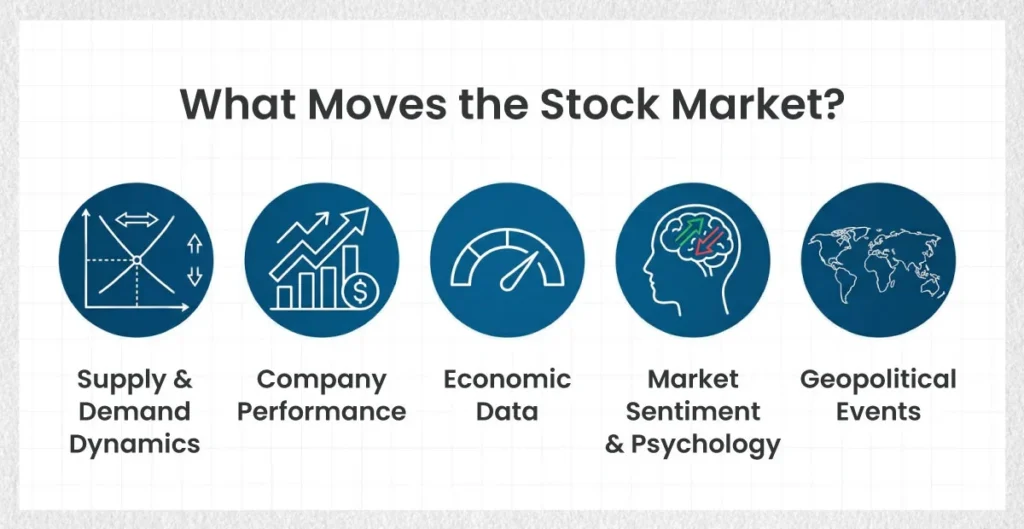
- Supply and Demand Dynamics: Changes in buying and selling activity directly influence stock prices and overall market movements. Simply, prices move because more people want to buy than sell (price rises) or more want to sell than buy (price falls).
- Company Performance: revenue growth, quarterly corporate earnings beating or missing expectations, merge and acquisition news, leadership changes, new products or services launches, analysts ratings and guidance about future performance and financial outlook.
- Economic Data: such as interest rates decisions from central banks. higher rates often pressure stock prices down and makes bonds become more attractive. Other key data are inflation, and employment reports, can influence stock market performance by affecting economic growth expectations, corporate profitability and investor sentiment.
- Market sentiment and Psychology: Investor emotions such as confidence, fear, greed, and uncertainty can strongly influence stock prices, even in the absence of new fundamental information. Changes in sentiment may lead to herd behaviour, where investors collectively buy or sell stocks.
- Geopolitical Events: Political instability, wars, elections, trade disputes, sanctions, natural disasters, pandemics, and other global shocks can create uncertainty and disrupt economic activity, thereby influencing investor sentiment and stock market performance.
While various factors can influence overall market movements, investors also need to evaluate individual companies to identify potential opportunities and make informed decisions.
Quick Summary Matrix:
| Catalyst | Event Example | Typical Price Impact |
| Earnings Beat | Quarterly profit beats expectations | 📈 Positive |
| Fed Rate Hike | Central bank raises interest rates | 📉 Negative |
| Positive Guidance | Company upgrades annual revenue targets | 📈 Positive |
| Geopolitical Crisis | Trade tariffs or war outbreaks | 📉 Negative |
What is a Stock Ticker Symbol?
A stock ticker symbol is a unique series of letters assigned to a publicly traded company’s shares for identification and trading purposes. Investors use ticker symbols to search for, track and trade stocks on stock exchanges and trading platforms.
Ticker symbols are typically chosen by the company when it lists its shares, subject to the approval and availability rules of the stock exchange.
Companies typically select ticker symbols that are related to their name or brand, easy for investors to recognize and remember, and not already in use by another company on the same stock exchange.
For example:
Apple trades under the ticker symbol (AAPL), Microsoft under (MSFT), JPMorgan Chase under (JPM) and The Coca-Cola Company under (KO).
How to Evaluate or Analyze Stocks?
To evaluate stocks, you need to consider analysing the following points:
- Company Financial Performance: Review the company’s revenue, profitability, debt levels, and cash flow to assess its financial health and ability to sustain future growth.
- Earnings Growth: Consistent growth in earnings may indicate strong business performance and could support higher stock valuations over time.
- Industry and Economic Conditions: Industry trends, economic growth, interest rates, and market conditions can significantly influence a company’s performance and stock price.
- Valuation Metrics (P/E Ratio): Metrics such as the Price-to-Earnings (P/E) ratio compare a company’s share price with its earnings, helping determine whether investors are paying a relatively high or low price for the stock compared with its peers or historical averages.
- Dividend Policy and Future Prospects: A company’s dividend payments and future growth plans can provide insight into its financial stability and long-term potential.
Finding a promising stock is only part of the journey. Investors must also understand how trades are executed and how they participate in the market.
What is Stock Trading?
Stock trading is the process of buying and selling shares of publicly traded companies through stock exchanges. The primary objective of stock trading is to profit from changes in stock prices and, in some cases, dividend payments.
Stock trading typically involves more frequent buying and selling to profit from shorter-term price movements unlike stock investing that generally focuses on long-term wealth creation.
While buying and selling individual stocks is a common way to participate in the market, investors have several other ways to gain exposure to stocks.
What are the Different Ways to Gain Exposure to Stocks?
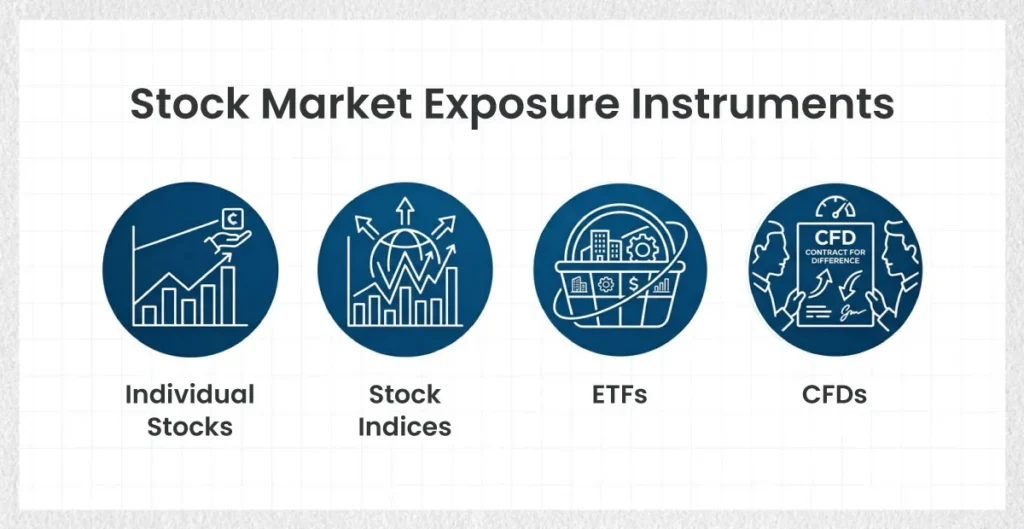
Investors can gain stock market exposure through various financial instruments, depending on their risk tolerance, experience level, and investment horizon. Here are the 4 most common ways, along with critical considerations for each:
- Individual Stocks:
Purchasing shares of a specific publicly traded company (e.g., Apple, NVIDIA) gives you direct ownership, full voting rights, and direct entitlement to corporate dividends.
Best For: Experienced investors seeking high-growth potential and outperforming the broader market.
Key Considerations:
- Single-Stock Concentration Risk: If a single company faces poor earnings, regulatory fines, or bankruptcy, your portfolio can suffer severe losses without a buffer.
- Requires Intensive Fundamental Analysis: Successful stock picking requires ongoing research into financial statements, management strategy, and competitive moats.
- Stock Indices:
Stock indices, such as the S&P 500, NASDAQ-100, or Dow Jones Industrial Average, provide exposure to a group of companies through a single instrument. They allow investors to track the performance of different segments of the stock market and achieve greater diversification compared with investing in individual stocks.
Best For: Macro-level market tracking and performance benchmarking.
Key Considerations:
- Cannot Be Purchased Directly: An index is merely a mathematical benchmark. To gain exposure to an index, investors must buy an index-tracking ETF or an index fund.
- Market-Cap Weighting Imbalance: Major indices like the S&P 500 are weighted by market capitalization. This means a few mega-cap tech giants can heavily distort the entire index’s performance, giving a false sense of full diversification.
- Exchange-Traded Funds (ETFs):
ETFs are investment funds that hold a basket of stocks and trade on exchanges like individual shares. They provide diversified exposure to sectors, regions, or broad market indices.
Example:
The SPDR S&P 500 ETF Trust (SPY), which tracks the S&P 500 Index, and the Invesco QQQ Trust (QQQ), which tracks the NASDAQ-100 Index.
Best For: Beginners and long-term passive investors seeking instant diversification and lower volatility.
Key Considerations:
- Expense Ratios Eat Into Returns: ETFs charge an annual management fee (Expense Ratio). Even a seemingly small 0.5% fee can significantly compound over decades and erode long-term wealth.
- Tracking Error Risk: Due to fund management costs, cash drag, or liquidity issues, an ETF’s total return may slightly deviate from the actual index it intends to mirror.
- Contracts for Difference (CFDs):
CFDs are financial derivatives that allow traders to speculate on stock price movements without owning the underlying shares. They offer the ability to profit from both rising and falling markets, often using leverage, but they also involve higher risk.
Best For: Advanced short-term tactical traders looking to hedge existing portfolios or profit from both rising and falling (shorting) markets.
Key Considerations & High-Risk Warnings:
- Leverage Amplifies Downside Risks: CFDs use leverage (margin trading), meaning a small price movement against your position can rapidly wipe out your entire trading capital.
- Overnight Financing Costs (Swap Fees): Holding CFD positions overnight incurs daily interest charges (swaps), making them unsuitable for long-term “buy-and-hold” investing.
- No Shareholder Rights: CFD holders do not own equity, receive physical dividend distributions, or hold company voting rights.
Accessing the stock market has become easier through various instruments but knowing how to trade effectively and protect capital is essential for long-term success.
How to Trade Stocks and Manage Risks?
- Choose a Reliable Broker: Select a regulated broker that provides access to your preferred stock markets, offers a secure trading platform and provides suitable tools and services for your trading needs.
- Learn and Practice with a Demo Account: Before investing real money, familiarize yourself with trading platforms, order types and basic risk management techniques through a demo account.
- Conduct Thorough Research: Analyze company fundamentals, financial performance, industry trends, economic conditions and valuation metrics, such as the P/E ratio, before making trading decisions.
- Develop a Trading Plan: Establish clear investment objectives, entry and exit strategies, profit targets and acceptable risk levels before opening a position.
- Determine Position Size and Diversify: Decide how much capital to allocate to each trade and avoid concentrating all investments in a single stock or sector to reduce concentration risk.
- Manage Risk Effectively: Use take profit and stop-loss orders to limit potential losses and avoid excessive leverage, as it can significantly amplify both gains and losses.
- Place and Monitor the Trade: Execute the trade using appropriate order types and stay informed about company announcements, earnings releases, economic data, and geopolitical developments that may affect stock prices.
- Review Performance and Control Emotions: Regularly evaluate trading performance, adjust strategies when necessary and avoid making impulsive decisions driven by fear, greed, or market speculation.
The stock market offers various opportunities, but successful participation requires more than simply buying shares. A strong understanding of stock fundamentals, market dynamics, analysis techniques and risk management can help investors make more informed decisions and better manage their exposure to market fluctuations.
Summary Checklist for Beginners:
| Goal | Recommended Tool | Primary Benefit |
| Broad Market Growth | S&P 500 Index ETF (e.g., SPY) | Low cost, instant diversification |
| Individual Company Upside | Single Shares (Common Stock) | Full capital appreciation & voting rights |
| Passive Income Focus | High-Yield Dividend Stocks / Value Funds | Regular cash distribution payouts |
| Short-Term Tactical Hedging | Derivatives / CFDs (High Risk) | Ability to short/long with leverage |
Disclaimer:
This publication is provided strictly for educational and informational purposes and does not constitute financial, legal, or investment advice. Stock trading and derivative investments carry inherent financial risk of capital loss. Always perform independent research or consult a licensed professional financial advisor before executing trades.