Benjamin Graham transformed the way investors evaluate stocks by emphasizing the difference between a company’s market price and its underlying value. Often regarded as the Father of Value Investing, Graham developed a disciplined approach centred on intrinsic value, financial strength and the margin of safety, principles that continue to influence investors decades later.
But what exactly made Graham’s approach so influential, and how can investors apply his ideas today? In this article, we explore Graham’s early life and the experiences that shaped his investment philosophy; his core value-investing principles, stock-screening rules, and the Graham Number formula; his differences with Warren Buffett; his most important books; and the continued relevance of his strategy in today’s markets.
Key Takeaways:
- The Pioneer: Benjamin Graham is the father of modern financial analysis and value investing.
- Core Philosophy: Always maintain a “Margin of Safety” and treat stock market fluctuations as the emotional offerings of “Mr. Market”.
- Practical Tools: Developed the 7 criteria for defensive investors and the popular “Graham Number” formula.
- Legacy: Mentored Warren Buffett, shifting investment from pure speculation to rigorous fundamental research.
So Is Benjamin Graham’s Value Investing Still Relevant Today?
Yes, Benjamin Graham’s approach remains relevant, but some of his traditional methods need to evolve with modern markets. While traditional valuation rules may not suit every technology or high-growth company, his core principles of intrinsic value, discipline and margin of safety remain valuable for investors.
So, Graham’s exact formulas may not fit every modern company, but his fundamental approach to disciplined, rational and value-focused investing remains applicable.
The following points explore how his approach can be adapted to today’s market:
- Modern Market Challenges: Traditional rules such as P/E < 15 or P/B < 1.5 may be less effective for today’s tech-heavy and high-growth companies.
- Timeless Principles: While valuation measures can change, Graham’s core ideas assessing intrinsic value, understanding Mr. Market’s fluctuations and maintaining a margin of safety remain relevant.
- Adapting to Today: Investors can combine Graham’s discipline with modern metrics such as free cash flow, earnings quality and competitive advantages.
Graham’s Early Years, From Childhood to Wall Street
Long before he became known as the Father of Value Investing, Benjamin Graham was the youngest of three sons in a family that moved from London to New York when he was just one year old. His father ran a business selling household goods, but died when Graham was only nine, leaving his mother to raise three young boys. The family faced financial difficulties after his death, giving Graham an early understanding of how quickly financial security could disappear.
Despite these challenges, Graham was an exceptional student. He graduated from Columbia College in 1914 as the salutatorian of his class at just 20 years old. Although Columbia offered him teaching positions in mathematics, English and philosophy, he chose to work on Wall Street because he needed to help support his mother and siblings. That decision marked the beginning of a career that would eventually transform the way investors thought about value and risk.
His early career exposed him to the excitement and optimism of the booming stock market. But the 1929 stock market crash shattered that confidence.As stock prices collapsed and investors suffered heavy losses, Graham saw firsthand how dangerous it could be to rely on rising markets or optimistic expectations.
From Speculation to Systematic Analysis
The 1929 crash reinforced Graham’s belief that investing needed to move beyond speculation and market excitement. Working with David Dodd, a professor at Columbia Business School, Graham developed a more disciplined approach based on studying financial statements, earnings, assets and a company’s underlying value. Their work eventually led to the publication of Security Analysis in 1934, helping establish a more systematic and rational framework for investment decisions.
Putting His Ideas into Practice
Graham did not limit his ideas to his books and investment research. In 1936, he established the Graham-Newman Corporation, where he put his investment principles into practice. The firm invested in undervalued securities and used strategies such as arbitrage and hedged positions. Its analytical and systematic approach reflected Graham’s belief that careful research and disciplined decision-making could provide a more reliable foundation for investing than market speculation.
Through his research, writing and investment practice, Graham developed a philosophy centered on understanding a company’s underlying value rather than simply following market prices. These ideas became the foundation of value investing and influenced generations of investors.
Now that we’ve explored Graham’s early life and the experiences that shaped his career, it’s time to look at the key principles behind his investment philosophy.
What Are the Core Principles of Benjamin Graham’s Value Investing Strategy?
Graham’s value investing strategy is shaped around key principles that help investors distinguish between price and value while managing risk. These principles provide a disciplined framework for investment decisions.
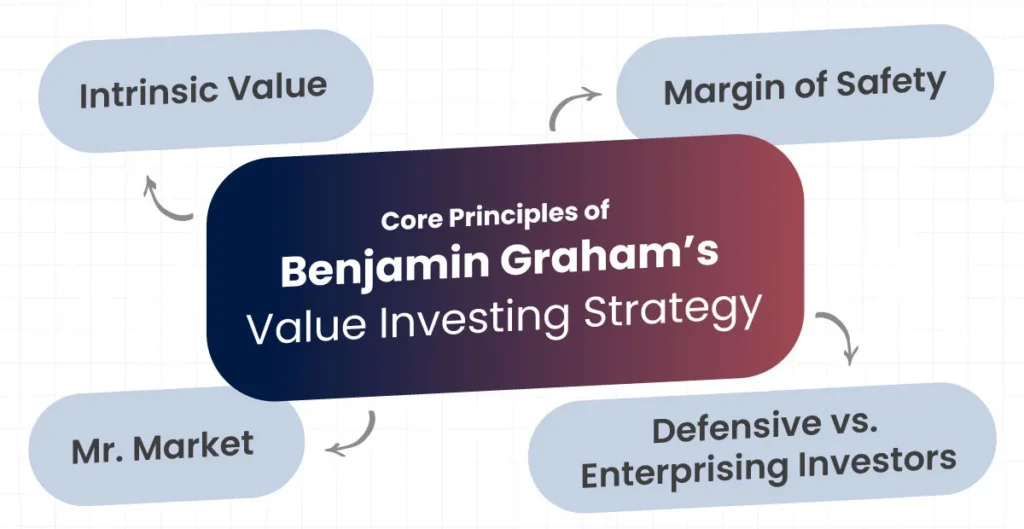
- Intrinsic Value: The estimated true worth of an investment based on the company’s financial strength, earnings, assets and future prospects, rather than its current market price. Graham believed investors should analyse these factors to determine whether a stock is trading below its intrinsic value. The goal is to avoid overpaying and identify opportunities where the market price does not fully reflect the company’s underlying value.
- Margin of Safety: One of Graham’s core investing concepts. It means buying a stock at a price sufficiently below its estimated intrinsic value, creating a cushion against mistakes, unexpected problems or errors in analysis. The greater the gap between the purchase price and intrinsic value, the greater the potential protection against losses.
Example:
If an investor believes a stock is worth $50 but buys it for $35, the lower purchase price gives them some protection if the stock’s true value turns out to be lower than expected. This difference is the margin of safety.
- Defensive vs. Enterprising Investors: Graham divided investors into defensive and enterprising investors based on the time and effort they were willing to devote to investing. Defensive investors prioritize simplicity and stability by following established investment rules, choosing financially strong companies and maintaining diversification. Enterprising investors are willing to devote more time and effort to research to identify undervalued investments and special opportunities.
Note:
The key difference is the level of involvement: defensive investors seek a simpler, lower-effort approach, while enterprising investors are willing to conduct deeper research to find attractive opportunities.
- Mr. Market: Mr. Market is Graham’s metaphor for the stock market’s emotional and unpredictable behaviour. He imagined the market as a business partner who may offer very different prices for the same investment depending on whether he is optimistic or pessimistic. Investors should not let these shifting moods influence their decisions or confuse price with value. Instead, they can take advantage of attractive prices when the market becomes overly pessimistic.
Example:
If concerns about the economy cause investors to panic and push a stock from $50 to $35, an investor following Graham would not panic and sell simply because Mr. Market is pessimistic. Instead, the investor would assess the company’s fundamentals and determine whether the lower price creates an attractive opportunity relative to its underlying value.
But how did Graham turn these principles into practical investment decisions? His stock-screening rules and Graham Number gave investors a systematic way to identify financially strong companies trading at attractive valuations.
What Are Graham’s Stock Screening Rules and the Graham Number Formula?
Graham’s Stock Screening Criteria:
Stock screening is the process of using specific financial rules to filter stocks and identify companies that meet certain investment requirements.
Benjamin Graham developed screening criteria to help investors identify financially strong companies trading at reasonable valuations. His approach generally focused on adequate company size, strong financial condition, stable earnings, a consistent dividend record, moderate P/E (price-to-earnings) and P/B (price-to-book) ratios, and a reasonable combined valuation based on earnings and book value.
These criteria were designed to reduce risk and filter out companies with weak financial fundamentals or excessive valuations. While the exact requirements varied by investor type, the overall goal was to find stable, undervalued stocks with a margin of safety.
Graham’s 7 Defensive Stock Selection Criteria:
For defensive investors, Benjamin Graham proposed seven screening criteria designed to identify financially strong companies trading at reasonable prices.
- Adequate Company Size: The company should be sufficiently large to reduce the risks associated with smaller businesses. Graham considered larger companies generally better positioned to withstand economic downturns and business challenges.
- Strong Financial Condition: The company should have a strong financial position, with sufficient current assets relative to current liabilities and manageable long-term debt. This criterion helped Graham reduce financial risk and identify companies with stronger balance sheets.
- Earnings Stability: The company should have positive earnings for each of the past 10 years, showing a consistent ability to generate profits.
- Consistent Dividend Record: The company should have paid dividends continuously for at least 20 years, demonstrating a long history of returning capital to shareholders.
- Moderate P/E Ratio: The stock should have a price-to-earnings (P/E) ratio of 15 or less, helping investors avoid paying excessive prices for the company’s earnings
- Moderate P/B Ratio: The stock should have a price-to-book (P/B) ratio of no more than 1.5, keeping the market price reasonably close to the company’s book value.
- Moderate Combined Valuation: The P/E ratio multiplied by the P/B ratio should not exceed 22.5. This provides an additional check that the stock’s overall valuation remains within Graham’s preferred range.
Graham Number:
The Graham Number is a formula developed from Benjamin Graham’s value investing principles to estimate the maximum price an investor might consider reasonable for a stock based on its earnings and book value. It is mainly used as a screening tool to identify potentially undervalued stocks. If a stock’s market price is below its Graham Number, it may suggest that the stock is trading at an attractive valuation.
The Graham Number is calculated using the following formula:
Graham Number = √ (22.5 × EPS × BVPS)
- 22.5: This constant comes from multiplying Graham’s maximum P/E ratio of 15 by P/B ratio of 1.5 (15 × 1.5 = 22.5).
- EPS (Earnings Per Share): Measures how much profit a company generates for each share.
- BVPS (Book Value Per Share): Represents the value of the company’s net assets attributable to each share.
- Purpose of the formula: By combining earnings and book value, the Graham Number provides an estimate of a stock’s fair value and can help investors identify potentially undervalued stocks.
Example:
Suppose a Company has EPS: $4 and BVPS: $25and a current share price of $40. Using the formula: Graham Number = √ (22.5 × 4 × 25) = √2,250 = $47.43
Since the company’s current share price of $40 is below its Graham Number of $47.43, the stock may be considered undervalued under the formula. This could indicate that the stock is worth further consideration by an investor seeking undervalued opportunities.
However, the Graham Number alone should not be the sole reason to buy the stock; investors should also assess the company’s financial health, prospects, and other valuation factors before deciding.
Limitations of the Graham Number
- Limited inputs; rely mainly on EPS and book value.
- Less suitable for some companies: The Graham Number may not work well for high-growth or asset-light businesses, such as software, technology and consulting companies that rely less on physical assets. For example, a software company may have few factories, machines or inventory but still generate strong profits and have significant growth potential. Because the Graham Number includes book value, it may underestimate the value of such a business.
- Ignores future prospects; does not account for future growth or earnings potential.
- Not a standalone measure; should be combined with other financial and fundamental analysis.
- Does not guarantee undervaluation; a stock trading below its Graham Number is not necessarily a good investment.
After learning about Graham’s screening rules and valuation formula, let’s explore how his approach compares with the investment philosophy of Warren Buffett, one of his most influential students.
Benjamin Graham vs. Warren Buffett: How Do Their Investment Strategies Differ?
Before comparing Benjamin Graham and Warren Buffett, it is important to note that Buffett’s investment philosophy was strongly influenced by Graham’s teachings. Buffett studied under Graham at Columbia Business School and later worked at Graham-Newman, his investment firm. Graham’s principles of intrinsic value, margin of safety and disciplined investing became the foundation of Buffett’s approach.
However, as the comparison below shows, Buffett gradually developed his own investment style. While Graham placed greater emphasis on financial strength and buying undervalued stocks at attractive prices, Buffett expanded on these principles by focusing more on business quality, competitive advantages and long-term growth.
| Benjamin Graham | Warren Buffet | |
|---|---|---|
| Investment Philosophy | Focuses on buying investments below their intrinsic value, with a strong emphasis on protecting against losses. | Builds on Graham’s principles while placing greater emphasis on owning excellent businesses for the long term. |
| Margin of Safety | A core concept; seeks to buy stocks at a significant discount to their estimated intrinsic value. | Still important but combined with an emphasis on business quality. |
| Time Horizon | Focus on buying undervalued stocks and may sell them once their market price reaches their estimated intrinsic value. However, he also recommended a long-term approach for defensive investors. | Generally, favors long-term ownership of strong businesses. |
| Growth Consideration | Considers growth, but places greater emphasis on current valuation, financial strength and a margin of safety. | Places greater emphasis on long-term growth and a business’s ability to compound value. |
| Diversification | Favoured broad diversification across many undervalued stocks. | Generally, favors greater concentration in businesses he understands and has high conviction in. |
| Famous Concept or Quote | Mr. Market: The stock market can behave emotionally, offering different prices depending on whether it is optimistic or pessimistic. | Price is what you pay. Value is what you get (Emphasizes the difference between an investment’s price and its underlying value). |
| Risk Management | Uses a margin of safety and diversification to help protect against losses. | Focuses on understandable, high-quality businesses and avoiding investments where the risks are not well understood. |
For investors looking to explore Graham’s investment philosophy in greater depth, his So, we can say that Benjamin Graham and Warren Buffett share the same core foundation of value investing. The main difference is in what they emphasize when selecting investments. Graham places greater emphasis on valuation, financial strength, and finding undervalued stocks, while Buffett, building on Graham’s principles, places greater emphasis on business quality, competitive advantages, strong management, long-term growth, and the ability to compound value over time.
Books offer valuable insights into the ideas and principles that shaped value investing. Let’s take a look at some of his most influential publications.
What Are Top Essential Benjamin Graham Books Every Investor Must Read?
Graham’s books provide a deeper look into the principles, strategies and analytical methods behind his approach to investing. From beginner-friendly concepts to detailed financial analysis, his writings offer valuable lessons for investors at different levels. Here are three of his most essential books for anyone looking to understand his investment philosophy.

1- Security Analysis (1934):
Co-authored by Benjamin Graham and David Dodd, Security Analysis is often regarded as the “bible” of value investing and financial analysis. The book provides a detailed framework for evaluating securities based on factors such as earnings, assets and financial strength. It teaches investors to look beyond market prices and assess an investment’s underlying value. It is particularly useful for professional analysts and investors who want a deeper and more technical understanding of fundamental analysis.
2- The Interpretation of Financial Statements (1937):
The Interpretation of Financial Statements is a practical guide to understanding a company’s financial information. It explains how to read and analyse key documents such as the balance sheet and income statement. Graham shows investors how to use financial data to assess a company’s profitability, financial position, and overall strength. The book provides a useful foundation for making more informed investment decisions, so it suits beginner investors and readers who want to learn to analyse financial statements before moving into more advanced investment analysis.
3- The Intelligent Investor (1949):
The Intelligent Investor is Benjamin Graham’s most well-known book and a classic introduction to value investing. It explains key concepts such as intrinsic value, margin of safety and Mr. Market. Graham also distinguishes between defensive and enterprising investors based on their level of involvement and risk tolerance. The book emphasizes discipline, patience and avoiding emotional investment decisions. So, this book is considered the best for beginners who want to understand the foundations of value investing and develop a disciplined, long-term approach to making investment decisions.
Summary Comparison Table:
| Points of Comparison | Security Analysis (1934) | The Interpretation of Financial Statements (1937) | The Intelligent Investor (1949) |
|---|---|---|---|
| Main Focus | Detailed security and fundamental analysis | Understanding financial statements | Core principles of value investing |
| Key Topics | Earnings, assets, valuation and financial strength | Balance sheets, income statements and financial health | Intrinsic value, margin of safety, Mr. Market, investor discipline |
| Level | Advanced and technical | Beginner-friendly | Beginner-friendly |
| Best For | Professional analysts and advanced investors | Beginners learning financial statement analysis | Beginners and individual investors |
| Main Goal | Learn how to deeply evaluate securities | Learn how to assess a company’s financial condition | Build a disciplined, long-term investment approach |
Final Thoughts
Benjamin Graham’s ultimate legacy rests on a fundamental distinction: market price is merely what Mr. Market asks, whereas intrinsic value is what the business is actually worth.
While rigid quantitative metrics must be adapted for modern asset-light economies, his timeless principles—margin of safety, balance sheet discipline, and emotional detachment from market volatility—remain the ultimate playbook for long-term investors.
Disclaimer:
The information provided in this article is for educational and informational purposes only and should not be construed as financial, investment, or legal advice. Financial markets, stock selection criteria, and valuation formulas discussed—such as those by Benjamin Graham—are historical frameworks and may not be suitable for every investor or modern market condition. Always perform your own due diligence, evaluate your risk tolerance, and consult with a certified financial advisor before making any investment decisions.