Thanks to gold’s enduring value as both a store of wealth and a safe-haven asset, purchasing physical gold has been a popular investment choice among investors for decades. However, in today’s fast-paced financial markets, understanding what gold is and how to trade gold has become increasingly important, as speculating on global gold prices offers traders and investors new opportunities to capitalize on price movements.
In this article, you’ll learn what gold trading is and explore its different forms, from buying gold bullion and investing in gold stocks to trading spot gold, futures, options, ETFs, and gold CFDs. We’ll outline the key differences between each type, explain how gold trading works, and address the most frequently asked questions about this market.
What is Gold Trading?
Gold trading, in simple terms, refers to any method of buying and selling gold, whether in physical form (such as bullion and coins) or via financial instruments like futures, ETFs, mining stocks, and CFDs. Instead of holding gold purely for long-term value preservation, many traders seek to capitalize on short- or medium-term price movements driven by economic, political, and currency factors.
Gold trading remains popular because it often retains its value during periods of economic uncertainty, making it both a speculative opportunity and a protective asset within a diversified portfolio.
Now that you understand what gold trading is, let’s dive deeper into this market and explore the different types of gold trading.
What Are the Different Types of Gold Trading?
There are several ways to trade gold, and each comes with its own benefits and drawbacks. Based on your trading strategy, costs, and risk tolerance, you can choose the option that best fits your needs. Gold investing can range from buying and selling physical gold bullion or investing in gold stocks to more modern approaches such as trading derivatives like spot gold, futures, options, ETFs, and gold CFDs.
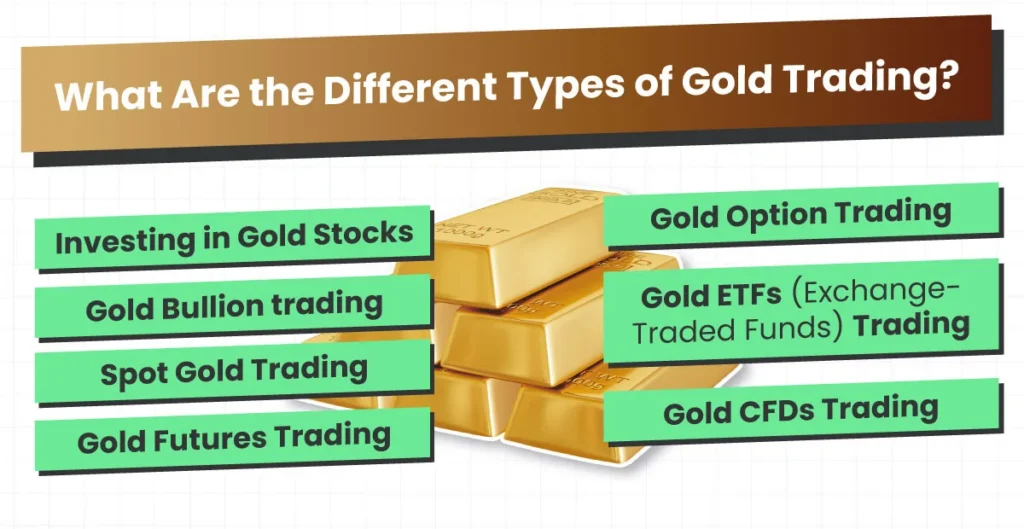
In this section, we will explore each type of gold trading in detail.
- Gold Bullion trading:
Gold bullion refers to physical gold in the form of bars, ingots, or coins, valued primarily by its weight and purity rather than its collectable or artistic value. It is considered one of the most traditional and tangible forms of gold investment.
Investors trade bullion by purchasing gold bars, ingots, or coins and holding them for the long term, typically as a hedge against inflation and currency devaluation. Since gold is widely recognized as a store of value, bullion can be resold relatively easily to gold retailers, dealers, or financial institutions if the investor needs cash.
Disadvantages or Drawbacks
While owning physical bullion offers security against economic uncertainty, it comes with several challenges:
- Storage Costs: Keeping gold in a secure place such as a bank vault can be expensive, and costs may vary depending on your country of residence.
- Security Risks: Storing gold privately at home or in an office carries the risk of theft.
- Production and Acquisition Costs: Physical gold carries production costs (minting and refining fees).
- Full Capital Requirement: Purchasing bullion requires paying the full amount upfront, with no leverage or instalment options.
While owning gold bullion is the most traditional way to invest in gold, some investors prefer a more indirect approach, buying shares in gold-related companies. Let’s have a look at investing in gold stocks.
- Investing in Gold Stocks:
Some investors gain exposure to gold by investing in the stocks of gold-related companies, such as major gold mining firms, producers, refineries, or jewelry manufacturers. Buying and selling these stocks provides partial exposure to the gold market, as their prices often fluctuate in response to gold-related factors.
For example, changes in gold prices can directly impact their asset/storage values, the revenues and profitability of refineries, which in turn affect their stock prices. While the performance of these companies may correlate with the price of physical gold, this correlation is not always consistent due to other business and market factors.
For investors seeking to avoid the liquidity constraints, storage challenges, and other logistical issues associated with owning physical gold, stocks of gold mining and production companies are often viewed as a practical alternative.
Drawbacks of Investing in Gold Stocks:
- Limited trading hours can limit flexibility compared to 24/5 markets, such as gold CFDs.
- Requires relatively larger capital to build a meaningful position.
- Company-specific risks (e.g., operational issues, management changes, geopolitical factors) can affect stock performance even if gold prices rise.
- Stock prices may sometimes move independently of gold prices, reducing the direct benefit of gold exposure.
Unlike stocks, spot gold trading allows you to engage directly with gold’s live market price, reacting instantly to market movements. See the following section exploring spot gold trading.
- Spot Gold Trading:
Spot gold refers to the current price at which gold can be bought or sold for immediate delivery. In the global financial markets, the spot price is quoted per troy ounce in US dollars and fluctuates in real time based on global supply and demand, as well as external economic and geopolitical factors. Unlike futures contracts, spot gold has no set delivery date.
How It Works:
- Check the live spot price of gold.
- Place a buy order with a broker or trading platform that offers spot gold trading.
- The trade is settled immediately or within T+2 days (two working days).
- If the price rises, you can close your position and take the profit.
- If you expect the price to drop, you can go short (sell) to profit from the downward movement.
Where Is Spot Gold Traded?
Spot gold is traded 24 hours a day across major global trading hubs, including:
- London – London Bullion Market Association (LBMA)
- New York – COMEX (Commodity Exchange)
- Zurich – Swiss gold trading hub
- Hong Kong – Asian market gateway
- Shanghai – Shanghai Gold Exchange (SGE)
| Pros | Cons |
| High liquidity with round-the-clock global trading. | Requires a trusted and regulated broker with a platform that supports spot gold trading. |
| No delivery date, offering more flexibility for short-term trading. | Prices can be volatile due to geopolitical or economic news, making it risky and requiring a high level of risk management. |
| Direct exposure to gold price movements without owning physical gold. | Short-term focus may lead to higher transaction costs for frequent traders. |
For those looking for more leverage and structured contracts, gold futures offer a standardized way to trade gold at a set price and date. Let’s address gold futures trading in the following part.
- Gold Futures Trading:
Gold futures are standardized contracts to buy or sell a specific amount of gold at a predetermined price on a set future date. They are traded on regulated exchanges, such as the COMEX (a division of the CME Group). Futures allow traders to speculate on the direction of gold prices without owning physical gold.
How to Trade Gold Futures:
- Open an account with a broker that offers futures trading.
- Choose a contract (e.g., COMEX Gold Futures – typically 100 troy ounces per contract).
- Decide your position:
- Go long if you expect gold prices to rise.
- Go short if you expect prices to fall.
- Meet the margin requirements (only a fraction of the contract value is needed to open a position).
- Close or roll over the contract before expiry to realize profits or cut losses, or take delivery if applicable (rare for speculators).
| Pros | Cons |
| Leverage: Control a large gold position with a smaller initial margin. | High risk from leverage: Losses can exceed the initial margin if prices move against your position. |
| Liquidity: Gold futures are actively traded, making it easier to enter and exit positions. | Limited trading hours compared to spot gold, though extended hours are available. |
| Hedging: Useful for miners, jewelers, and investors to protect against price fluctuations. | Complexity: Requires understanding of futures contracts, margin calls, and rollovers. |
| Price transparency: Traded on regulated exchanges with standardized contracts. | Potential for rapid price swings due to economic or geopolitical events. |
Options built on the futures market by adding flexibility, traders can secure the right, but not the obligation, to buy or sell gold at a predetermined price. Let’s check how they’re working.
- Gold Option Trading
A gold option is a financial contract where the underlying asset is either physical gold or gold futures.
- A call option gives the holder the right, but not the obligation, to buy gold at a predetermined price (strike price) within a specific time frame.
- A put option gives the holder the right, but not the obligation, to sell gold at a predetermined price.
All contract details, such as delivery method, quantity, strike price, and expiration date, are predetermined.
How to Trade Gold Options
Gold options are traded on regulated exchanges, including:
- COMEX (part of the CME Group) in the United States
- Tokyo Commodity Exchange (TOCOM) in Japan
- Multi-Commodity Exchange (MCX) in India
Some brokers also offer over-the-counter (OTC) gold option products.
Pros and Cons of Gold Options:
| Pros | Cons |
| Flexibility: Choose between calls and puts to profit from rising or falling gold prices. | Loss of value over time: Option value erodes as expiration approaches. |
| Limited risk for buyers: Maximum loss is limited to the option premium paid. | Complexity: Requires understanding of option pricing, volatility, and Greeks. |
| Leverage: Control a larger gold position with a smaller upfront cost. | Liquidity risk: Some option contracts may have low trading volume, leading to wider bid-ask spreads. |
| Hedging tool: Can protect other gold investments from adverse price movements. | Premium cost: Can be expensive in high-volatility markets. |
For a hassle-free and more accessible way to gain gold exposure, Gold ETFs bring the metal’s performance to the stock exchange without the need to manage physical holdings. Discussed in the following part.
- Gold ETFs Trading: (Exchange-Traded Funds)
Gold ETFs are exchange-traded funds that track the price of physical gold in the domestic market. They are considered a passive investment option linked to gold’s performance and are traded on stock exchanges like individual company shares.
How Gold ETFs Work:
Gold ETFs operate like mutual funds that are traded on stock exchanges. Each unit of a gold ETF represents a fixed quantity of physical gold (usually 1 gram), stored securely in vaults by the fund’s custodian. When you buy a gold ETF, you’re not physically taking delivery of gold; instead, you hold units that reflect the current market price of gold. The value of your investment moves in line with gold prices, and you can buy or sell these units throughout the trading day, just like stocks.
How to Trade Gold ETFs & Where
- Open a trading or Demat account with a registered broker.
- Search for a gold ETF listed on your preferred exchange.
- Place a buy or sell order like you would for any stock.
- Monitor price changes and sell when your target is met.
Where to Trade:
- NYSE (New York Stock Exchange) – e.g., SPDR Gold Shares (GLD).
- LSE (London Stock Exchange) – e.g., iShares Physical Gold ETC.
- NSE/BSE (India) – e.g., Nippon India Gold ETF.
Pros and Cons of Gold ETFs:
| Pros | Cons |
| Hassle-free way to invest in gold without physical storage issues. | Subject to market risk (systematic risk). |
| High liquidity – easily bought and sold on stock exchanges. | Capital gains tax may apply to profits. |
| Diversifies your portfolio and reduces concentration risk. | Management fees or expense ratios reduce net returns. |
| Acts as a hedge against inflation and currency depreciation | It may not perfectly track gold prices due to tracking error. |
While Gold ETFs provide a passive and convenient way to mirror gold’s price on stock exchanges, Gold CFDs offer a more active trading approach, allowing traders to speculate on gold price movements with leverage, in both rising and falling markets, without owning the underlying asset. Let’s learn more about gold CFD trading.
- Gold CFDs Trading:
Gold trading involves speculating on price movements in spot and futures markets. You can use derivatives like Contracts for Difference (CFDs) to trade gold without owning it physically and to take advantage of both rising and falling markets. Below are the core aspects you need to understand how to trade gold CFDs:
Placing Trading Positions
When you’re trading gold CFDs, you can capitalize on gold price movements without owning the physical gold. As we discussed above about gold CFDs, you can easily place orders based on your anticipation and analysis:
- If you anticipate gold prices will rise, you can go long (buy) to profit from upward movements.
- If you expect prices to fall, you can go short (sell) to profit from declines. CFDs make it possible to trade in both directions without owning the asset.
Trading Costs
The costs associated with CFD trading can be divided into two components:
- Spread: The difference between the buy (ask) and sell (bid) price of gold. In highly liquid markets, spreads are typically tighter, which reduces trading costs.
- Swap: Also known as an overnight financing fee, this is charged when you keep a position open overnight. Some brokers offer swap-free accounts for specific clients or under certain conditions.
Trading on Margin
CFDs allow you to use leverage, meaning you only need to deposit a fraction of the full trade value (margin) to open a position. This magnifies both potential profits and potential losses. For example, with 1:20 leverage, a $1,000 margin controls a $20,000 gold position.
Gold Trading Hours
Gold can be traded 24 hours a day, 5 days a week across three global sessions: the Asian (00:00–09:00 GMT), European (07:00–16:00 GMT), and U.S. (13:00–22:00 GMT) sessions.
The highest volatility and liquidity typically occur during session overlaps, especially the London–New York overlap between 13:00 and 16:00 GMT, as well as the transition from the Asian to European session between 07:00 and 09:00 GMT.
These periods often provide tighter spreads and more active price movements, offering prime opportunities for gold CFD traders.
Market Liquidity & Volatility
High liquidity generally means tighter spreads and faster order execution. However, gold is also sensitive to key economic data, central bank policies, and geopolitical events, which can cause high volatility, impacting both opportunities and risks.
Gold Trading Platforms
Popular platforms like MetaTrader 4 (MT4) and MetaTrader 5 (MT5) offer advanced charting tools, technical indicators, automated trading via Expert Advisors (EAs), and user-friendly interfaces, making them the preferred choice for many gold CFD traders.
Pros and Cons of Gold CFD Trading:
| Pros | Cons |
| High liquidity in global markets. | Leverage can amplify losses as well as gains. |
| Flexible, trade in both rising and falling markets. | Overtrading risk due to the ease of market access. |
| 24/5 trading hours, matching global gold market activity.. | Requires disciplined risk management. |
| No need for large capital, thanks to leverage. | OTC market, counterparty risk if the broker is unregulated. |
| No physical gold is involved; accessible anywhere with an internet connection. | Overnight costs or swaps can be high during periods of low liquidity, often accompanied by wider spreads. |
Now that we’ve explored all the major ways to trade gold, from physical bullion to advanced derivatives like CFDs. It’s time to compare these options side by side and highlight the key differences that can influence your trading decisions.
The Key Differences Between Gold Trading Types:
| Feature | Gold Bullion | Gold Stocks | Spot Gold | Gold Futures | Gold Options | Gold ETFs | Gold CFDs |
| Where Traded | Jewelry shops, gold dealers, banks | Stock exchanges | OTC market, broker platforms | Regulated commodity exchanges (e.g., COMEX) | Options exchanges (e.g., CME) | Stock exchanges | OTC via online brokers |
| Trading Hours | Business hours of dealers | Exchange hours | 24/5 | Exchange hours (extended hours possible) | Exchange hours | Exchange hours | 24/5 |
| Ownership | Physical gold | Shares of companies in the gold industry | No ownership (price speculation) | No ownership (contract-based) | No ownership (right to buy/sell) | No ownership (ETF holds gold) | No ownership (price speculation) |
| Capital Requirement | High (full payment upfront) | Medium to high | Flexible (depends on broker margin) | Medium to high (margin required) | Medium (premium payment) | Low to medium | Low (due to leverage) |
| Costs | Production, storage, insurance | Brokerage fees, capital gains tax | Spreads, possible commissions | Exchange fees, margin costs | Premiums, commissions | Management fees, brokerage fees | Spreads, overnight swap charges |
| Best For | Long-term wealth storage, inflation hedge | Indirect exposure to gold | Active traders/speculators | Experienced traders, hedging | Strategic traders, hedging | Passive investors, diversification | Active traders seeking flexibility |
Based on the key differences between the trading types illustrated, you can easily determine what type of trader you are and which method best fits your trading style, personality, and strategy.
Summary
Keep in mind that you can also combine multiple approaches. For example, you could divide your investment capital between purchasing physical gold and trading gold CFDs. This way, you hedge against inflation and currency devaluation through physical gold, while at the same time capitalizing on global gold price movements and hedging the value of your own gold holdings.
FAQs:
Why Do People Trade Gold?
There are three reasons why:
- Safe-Haven Demand: Gold is viewed as a store of value during periods of political instability, war or economic downturns.
- Inflation Hedge: Investors often turn to gold when currencies lose purchasing power.
- High Liquidity: Gold is one of the most actively traded commodities, making it easy to enter and exit positions.
Can beginners trade gold?
Yes, beginners can trade gold, especially through gold CFDs, as they can start with a small amount of capital thanks to leverage. They can also practice on a demo trading account provided by most CFD brokers before moving to a live account, aiming to make small profits with minimal risk.
Is trading gold a good idea?
Gold is considered a store of value as its price generally rises over the long term. It’s favored by investors, traders, and central banks to hedge against inflation and geopolitical risks. Allocating part of your portfolio to gold can help you benefit from its high liquidity, volatility, and frequent trading opportunities. Gold serves as a diversifier in an investment portfolio, helping manage risk.
Why is gold trading risky?
Gold trading is risky due to its high volatility, which can cause rapid price swings driven by key economic data, changes in interest rate policy predictions, and geopolitical events. Using leverage in products like CFDs can amplify both profits and losses. Additionally, market liquidity and sudden news can lead to wider spreads, increasing trading costs.