AI trading has quickly become one of the most talked-about concepts in financial markets. As artificial intelligence transforms global industries, everyday investors and institutional professionals alike are evaluating how trading AI tools can enhance their strategy, streamline technical analysis, and boost overall trading performance.
However, utilizing an AI trading bot is not a magic solution for effortless profits. Instead, it serves as an advanced analytical instrument that helps investors eliminate emotional bias and process complex market data at scale.
This guide breaks down what AI trading is, how a modern AI trader operates, the mechanics behind an AI trading app, real-world software examples, and essential risk management practices to protect your capital.
What is AI Trading and How Does It Work?
AI trading refers to the deployment of artificial intelligence, machine learning algorithms, and natural language processing (NLP) to analyze financial data, identify market patterns, predict price trends, and automatically execute orders.
Unlike simple rule-based algorithms, an AI trader actively learns from dynamic market environments. The main advantage of using trading AI lies in its ability to process gigabytes of data in milliseconds while executing trades without human emotion.
Key Characteristics of an Advanced AI Trader
- Adaptive Machine Learning: Rather than following rigid, static lines of code, an AI trader refines its predictive models over time as new market conditions emerge.
- Multi-Source Data Processing: A modern AI trading app can interpret massive datasets simultaneously, including historical price action, order book liquidity, macroeconomic releases, and real-time social sentiment.
- Natural Language Processing (NLP): Through integrated chatbots, investors can query their trading AI using plain language, asking for trend analysis or pattern recognition on demand.
- Automated & Disciplined Execution: Once predefined probability thresholds are met, the AI trading bot places buy or sell orders instantly via algorithmic brokers.
The 3-Step Mechanics of an AI Trading Bot
To understand how an AI trading bot operates, it helps to break down its internal workflow into three core steps:
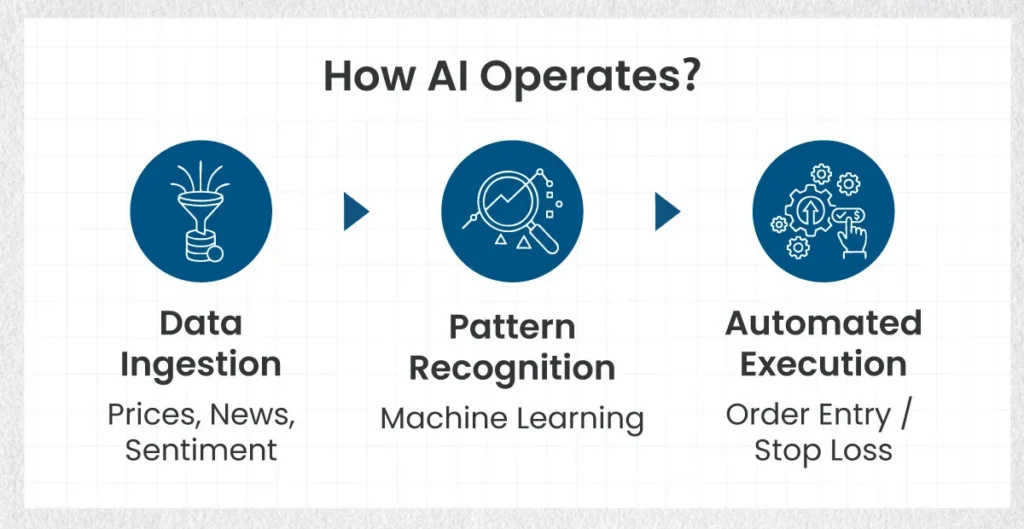
Step 1: Real-Time Data Ingestion
The AI trading bot continuously scans global markets, pulling data from multiple feeds simultaneously. This includes live order flow, technical indicators, historical chart patterns, financial news feeds, and sentiment metrics from platforms like X (Twitter) and Reddit.
Step 2: Pattern Recognition & Machine Learning
Once data is ingested, machine learning models compare current market behavior against years of historical price action. The system calculates statistical probabilities, identifies chart formations (such as head-and-shoulders or bull flags), and flags potential high-probability setups.
Step 3: Automated Order Execution
When technical and fundamental variables align with predefined risk rules, the AI trading app routes orders directly to the exchange within milliseconds. This rapid execution prevents slippage and removes human hesitation.
Human Trading vs. AI Trading: Why Traders Are Switching
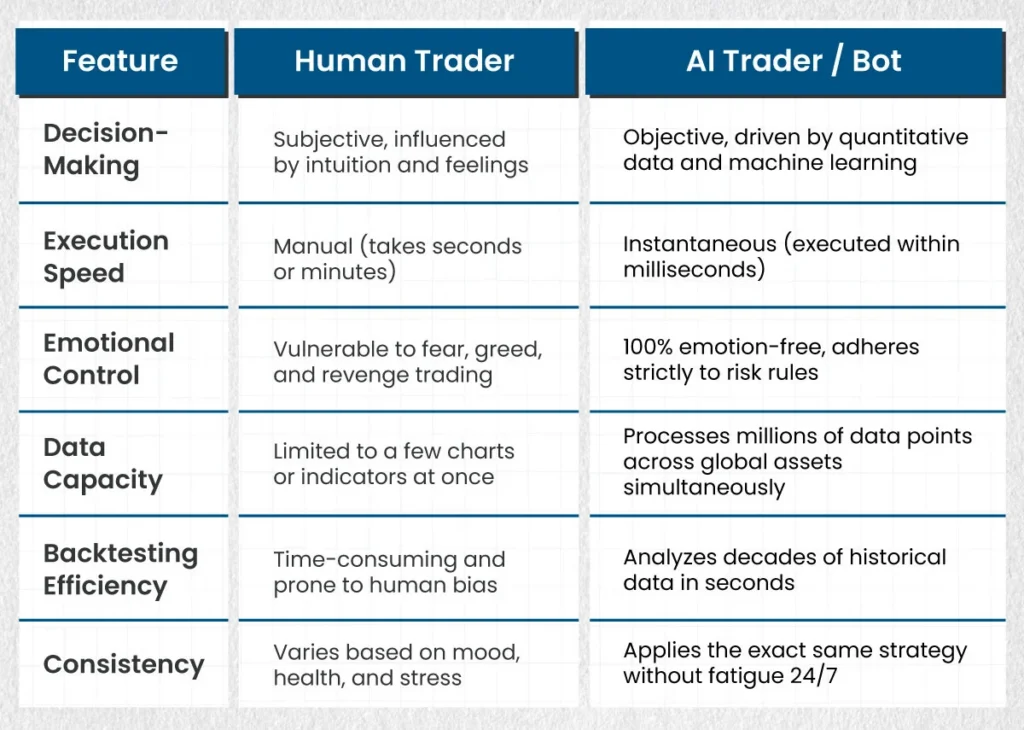
Human trading relies heavily on personal experience, intuition, and subjective judgment. However, human traders face physical constraints, such as fatigue, limited screen time, and emotional volatility.
By contrast, relying on a trading AI introduces a systematic, rule-based approach that operates around the clock.
The Two Major Advantages of AI Trading
- Eliminating Fear and Greed: Controlling emotions is often the hardest part of investing. Fear causes traders to cut winning trades too early or hesitate on valid entries. Greed leads to holding losing trades in hopes of a turnaround. An AI trading bot strictly follows logic, protecting capital regardless of market panic.
- Ultra-Fast Strategy Backtesting: Before risking real capital, a trading AI allows you to backtest trading rules across 10+ years of historical price action in seconds, verifying statistical edge before trading live.
Types of AI Trading Apps and Tools
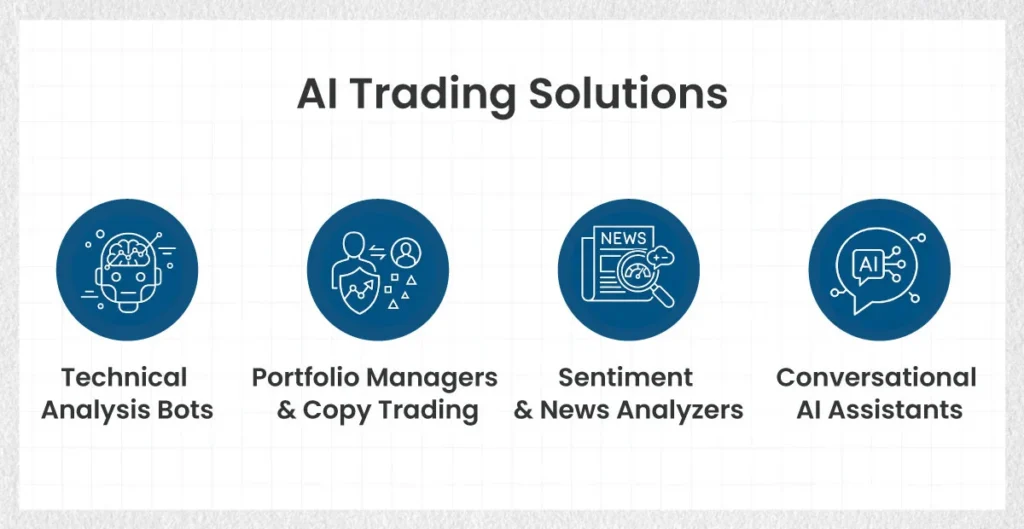
As AI trading continues to evolve, software solutions have split into specialized categories based on investor needs:
1. Automated Technical Analysis Bots
These bots scan thousands of charts 24/7 to identify support/resistance levels, chart patterns, and technical indicator crossovers. They automatically alert traders or enter market orders when a valid setup occurs.
2. Algorithmic Copy-Trading & AI Portfolio Managers
Often referred to as Robo-Advisors, these platforms build and rebalance diversified portfolios based on your financial goals and risk tolerance. Advanced systems allow users to copy the trades of top-performing algorithms automatically.
3. Sentiment Analysis & News Trading Bots
Market sentiment often shifts before price chart indicators react. Using Natural Language Processing (NLP), news-driven AI trading app tools scan headlines from Bloomberg, Reuters, and social media to gauge positive or negative market bias before executing news trades.
4. Conversational AI Trading Assistants
Designed as interactive AI co-pilots, these tools allow investors to converse with market data using plain natural language. Traders can ask the AI assistant to summarize market conditions, run custom chart queries, explain complex financial events, or generate custom indicator scripts without writing any code.
Real-World Examples of Dedicated AI Trading Platforms
To see how an AI trader operates in real market conditions, let’s examine two widely used platforms:
TradingView (AI Indicators & Pattern Recognition)
TradingView combines native auto-pattern detection with a vast library of third-party Machine Learning (ML) indicators built by its developer community.
Typical Workflow:
1. Open a Gold (XAU/USD) or equity chart.
2. Apply an Auto Chart Pattern tool or a custom ML forecasting indicator.
3. The platform automatically highlights pattern setups (e.g., Bullish Flag) and key momentum zones.
4. The trader cross-verifies volume profile and market trend before execution.
TrendSpider (Automated Technical Analysis & Sidekick AI)
TrendSpider is built specifically to streamline chart analysis by replacing manual drawing with algorithm-driven automation.
Key Features
- Automated Technicals: Automatically plots trendlines, support/resistance levels, and multi-timeframe Fibonacci retracements.
- Sidekick AI: An integrated natural language assistant that explains current chart dynamics, summarizes relevant news, and generates indicator scripts from conversational prompts.
- Best For: Intermediate and professional traders seeking to minimize manual charting and eliminate analysis paralysis.
Risk Warning:
Before deploying any AI indicator or automated tool in live markets, always backtest the strategy thoroughly and test it in a demo environment to evaluate its real-world accuracy.
How to Choose a Reliable AI Trading App Safely
With hundreds of automated tools available today, selecting a safe and reputable AI trading app is critical. Follow these guidelines to protect your financial security:
1. Verify Audited Backtesting Data
Never trust an AI trading bot that guarantees profits or hides past drawdown metrics. Always demand transparent, verified performance tracking using independent third-party platforms such as Myfxbook, BrokersView, FX Blue, TradesViz, MQL5, or direct broker-audited account statements.
2. Ensure Secure Broker API Integration
Ensure your AI trading app connects to established, regulated brokers via API keys.
Crucial Rule:
Never grant an external AI bot permission to *withdraw* funds from your broker account; restrict access solely to order execution.
3. Test in a Simulated Environment (Paper Trading)
Before funding a live account, connect your AI trader to a simulated demo account. Run the system for 30 to 60 days across volatile news events to evaluate how it handles real-time market slippage.
4. Set Rigid Risk Rules & Enable Kill Switches
Always configure strict risk parameters, including maximum daily drawdown limits and stop-loss orders. Ensure your platform supports a Kill Switch, a safety control that immediately shuts down all trading activity if market volatility exceeds safety limits.
The Dark Side of AI Trading: Key Risks & Limitations
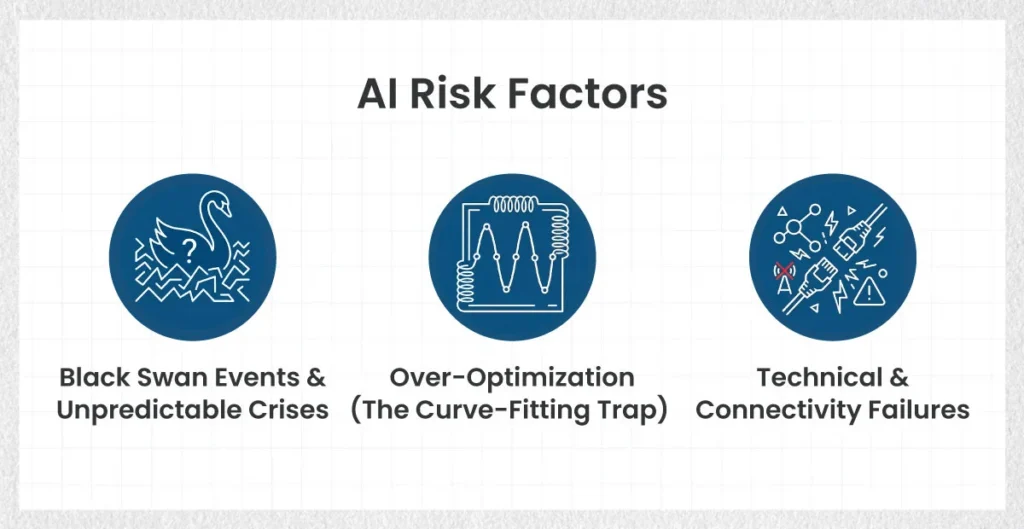
While AI trading offers powerful capabilities, automated systems carry distinct financial risks that every investor must understand:
1. Black Swan Events & Unpredictable Crises
AI models rely heavily on historical statistical probability. They excel in familiar market conditions but fail when encountering rare, unprecedented events, such as geopolitical conflicts, sudden macroeconomic policy shifts, or black swan market shocks. Lacking human intuition and broader contextual reasoning, automated systems can misinterpret extreme volatility, potentially triggering flash crashes or catastrophic liquidations before human traders can intervene.
2. Over-Optimization (The Curve-Fitting Trap)
A dangerous pitfall in quantitative trading is “over-fitting” or curve-fitting. AI developers often adjust strategy parameters so aggressively against past market charts that the system achieves near-perfect historical performance. However, because financial markets are constantly evolving, these over-optimized models fail miserably when exposed to live, unpredictable market conditions, memorizing noise rather than capturing true predictive signals.
3. Technical & Connectivity Failures
Automated trading relies on a complex tech stack involving broker APIs, cloud servers, data feeds, and local execution environments. System latency, API disconnects, platform downtime, or minor code bugs can prevent stop-loss orders from executing during high-volatility events, leading to severe execution slippage or unintended multi-order execution.
Frequently Asked Questions (FAQ)
Can an AI trading bot guarantee profits?
No. No AI trading bot algorithm, or machine learning model can guarantee financial profits. Financial markets carry inherent risk. AI trading is designed to improve analytical speed and statistical probability, not to eliminate risk entirely.
Do I need programming skills to use an AI trading app?
No. Most modern AI trading app platforms feature intuitive graphical interfaces, drag-and-drop strategy builders, or conversational prompts. However, while coding skills are not required, you must understand fundamental financial concepts, risk management, and technical analysis.
Is AI trading legal?
Yes. AI trading and algorithmic order execution are completely legal and heavily utilized by institutional funds, retail investors, and market makers worldwide. Always ensure your underlying broker is regulated by reputable authorities such as the SEC, FCA, or ASIC.
Disclaimer: This publication is provided strictly for educational and informational purposes and does not constitute financial, legal, or investment advice. Trading financial markets involves significant risk of capital loss. Always perform independent research and consult a licensed financial advisor before deploying automated trading systems.