Historically, gold has been one of the oldest forms of money, such as gold coins. Gold is considered a store of value as an investment asset, as well as a safe haven asset, which means that the asset enjoys unique characteristics, and gold is always considered a safe haven asset.
Being a safe haven-asset means that the asset enjoys unique characteristics, and gold is always considered a safe haven-asset. In this article, we will examine the five main characteristics of considering gold as a safe-haven asset and the pros and cons of trading gold and allocating it within your investment portfolio.
5 Key Characteristics That Make Gold a Safe-Haven Asset:
- Economic stability
- Protection against inflation
- Diversification
- Crisis adaptability
- Global Demand
Economic stability:
The world of finance is not expected, and no one can predict the changes that might happen, where the market always fluctuates due to several reasons, including economic crises, which can strike without warning. Gold has always proven that it has a high level of stability and financial security during these times of uncertainty.
Gold offers a store of wealth because its value increases throughout history. Unlike paper currencies, which lose their value over time due to inflation rates or economic collapse. Gold has an intrinsic value, and this is not a recent case; it has proven a reliable behavior during many past economic crises.
The global financial crisis of 2008, where the US housing market and subprime mortgages collapsed. This crisis is considered a systematic factor that led the major financial institutions to fail and caused a global recession. At this time, gold surged in value, and investors’ risk appetite decreased, focusing their investment on gold as a safe-haven asset.
Similar to the time of the COVID-19 pandemic in 2020, when the gold surged and reached a new all-time high of over $2000/ounce by August 2020. This was in response to high demand for safe-haven assets and hedging against the negative impacts on the whole economic situation.
Protection against inflation:
The gold price tends to rise during an inflationary economy. Exposure to gold reduces the risk of an asset’s adverse price movement and taking an opposite position in a related security. The link is not only between gold and inflation, but the yellow metal also protects against economic events like currency devaluation and uncertain political conditions.
Gold prices are related to the value of the US Dollar, because the gold is quoted by the USD (XAU/USD). Thereby, the stronger the USD, the lower the gold prices, and conversely, the weaker the USD, the higher the gold prices, due to higher demand for gold, then investors can afford to buy more gold as the dollar is weaker.
Diversification:
During the asset allocation process in the investment wallet, the wealth managers always called gold a diversifier. Gold offers diversification benefits because of its low correlation with other assets, such as shares, indices, and bonds.
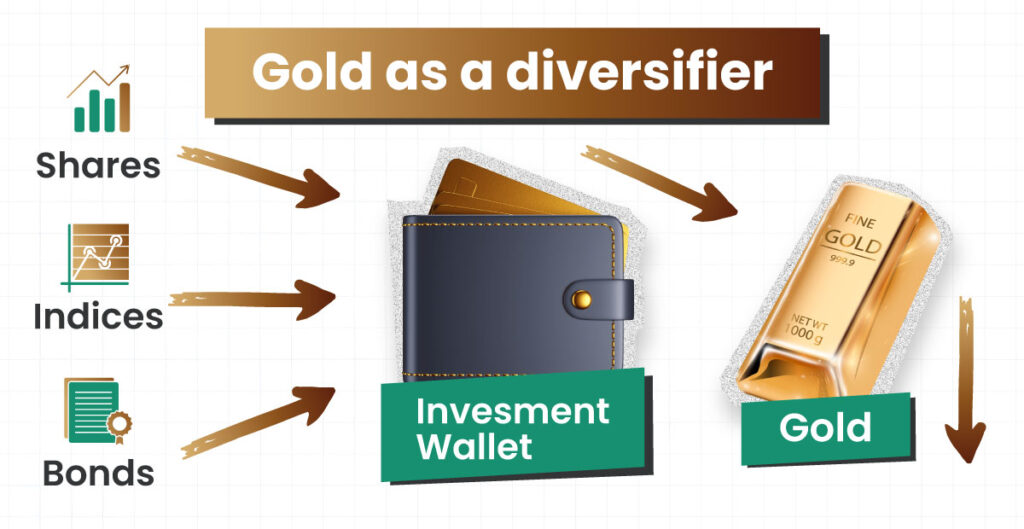
Gold typically moves in the opposite direction of other traditional investments, which provides an overall balancing effect and helps to reduce the portfolio risk when other traditional investments move up or down. Diversification is a fundamental principle to offset losses in one asset class with gains by adding a diversifying asset.
Crisis adaptability:
During global uncertainty and a financial crisis, investors tend to move their investments toward gold, because it acts like a shield for potential risks to their money or a decrease in value. Gold prices surge during uncertain times, like geopolitical tensions or a cooling financial market. For instance, when the pandemic of the covid-19 outbreaked, the traditional investment was negatively influenced, like the global stock market crashed and dropped sharply with an on-edge economy, gold’s prices surged and reached a new all-time high. Investors believed that gold could retain its value and turned their investment to this trusted asset.
Global Demand:
The world’s demand for gold is one of its characteristics as a safe-haven asset, contributing to its appeal. Gold is a precious metal with an intrinsic value, so it obtains continuous global demand not only for investment but also for various industrial applications such as electronics and dentistry, making gold highly desirable. The global demand for gold not only comes from investors, but the central banks also reserve amounts for gold and tend to increase their reserves during uncertain times.
Like any kind of investment class, gold investment has its advantages and disadvantages as well. So let’s check the pros and cons of trading safe-haven gold.
Pros and cons of gold as a safe-haven asset:
In this section, we will demonstrate the pros that safe-haven assets like gold offer, and also the unique cons that come with them.
| Pros | Cons |
| Less volatile behavior with no wide swings in value during volatile markets, unlike stocks. | Provides lower returns during stable times compared to equities or other high-risk investments. |
| Diversification characteristic that reduces risks and volatility in your investment portfolio. | Not entirely risk-free; gold can be volatile in the short term. |
| Gold is a safe-haven asset used for hedging against inflation. | Opportunity costs: heavy investment in gold may result in missing better investment opportunities elsewhere. |
After talking briefly about why gold is a safe-haven asset and the pros and cons of investing in safe-haven assets. We can turn our focus on the wondering question, which is commonly asked by beginners. What is the best way to invest in gold, and the way to start?
The best way to invest in gold is as a safe-haven asset:
The best way to invest in gold is trading gold in the Contract for Difference Markets (CFD), which allows investors to trade the direction of securities over a very short term and benefit from its price fluctuations. The advantage of Gold CFDs is that they require a lower capital, provide leverage, and a short-selling option, which allows investors to benefit from both rising and falling gold prices.
The way to start trading gold(a safe-haven asset):
You need to choose a trusted CFD broker to create a trading account, then get the trading platform through which you can start your trading journey. Choose a well-examined trading strategy to search for your opportunity, and choose “buy” to go long or “sell” to go short. Don’t forget to set a suitable position size based on risk management practice, and finally, keep monitoring your open positions.
Why is gold better than silver for investors? Gold vs. Silver:
Most investors, specifically traders, favored gold over silver. Silver is more volatile than gold, and being a part of industrial applications drives its demand and contributes to its volatility. Therefore, silver becomes more vulnerable to market fluctuations and economic downturns, which is why it has high volatility.
Unlike gold, it has more stability and its historically proven its role as a safe-haven asset, particularly during uncertain times, as we discussed above, its pros and characteristics. Thereby, traders prefer investing in gold over silver, for less risk and volatility, while gold is a more diversified asset than silver.
Conclusion:
Investing in a safe-haven asset is very useful for mitigating risks associated with the investment wallet, providing diversification for the portfolio. It’s important to understand well the characteristics of the safe-haven assets before allocating them within your investment portfolio. Gold safe-haven asset, has a unique characteristic that makes it a strategic asset that must be allocated within any investment portfolio, even in physical form or by trading the gold price through the CFD market to benefit from its price movements, benefiting from upside and downside opportunities.